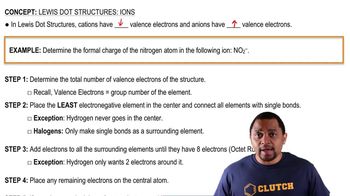
Calculate the formal charge on the indicated atom in each of the following molecules or ions: (a) the central oxygen atom in O3 (b) phosphorus in PF6- (c) nitrogen in NO2 (d) iodine in ICl3 (e) chlorine in HClO4 (hydrogen is bonded to O).
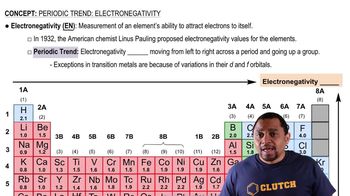
A major challenge in implementing the 'hydrogen economy' is finding a safe, lightweight, and compact way of storing hydrogen for use as a fuel. The hydrides of light metals are attractive for hydrogen storage because they can store a high weight percentage of hydrogen in a small volume. For example, NaAlH4 can release 5.6% of its mass as H2 upon decomposing to NaH(s), Al(s), and H2(g). NaAlH4 possesses both covalent bonds, which hold polyatomic anions together, and ionic bonds. (c) Based on electronegativity differences, predict the identity of the polyatomic anion. Draw a Lewis structure for this ion.
Verified step by step guidance
Verified video answer for a similar problem:
Key Concepts
Electronegativity
Ionic and Covalent Bonds
Lewis Structures
Although I3- is a known ion, F3- is not. (b) One of your classmates says that F3- does not exist because F is too electronegative to make bonds with another atom. Give an example that proves your classmate is wrong.
The substance chlorine monoxide, ClO(g), is important in atmospheric processes that lead to depletion of the ozone layer. The ClO molecule has an experimental dipole moment of 1.24 D, and the Cl—O bond length is 160 pm. (c) Using formal charges as a guide, propose the dominant Lewis structure for the molecule. (g), is important in atmospheric processes that lead to depletion of the ozone layer. The ClO molecule has an experimental dipole moment of 1.24 D, and the Cl—O bond length is 160 pm. (d) The anion ClO exists. What is the formal charge on the Cl for the best Lewis structure for ClO-?

The hypochlorite ion, ClO-, is the active ingredient in bleach. The perchlorate ion, ClO4-, is a main component of rocket propellants. Draw Lewis structures for both ions. (b) What is the formal charge of Cl in the perchlorate ion, assuming the Cl—O bonds are all single bonds?
(c) The measured dipole moment of BrCl is 0.57 D. If you assume the bond length in BrCl is the sum of the atomic radii, what are the partial charges on the atoms in BrCl using the experimental dipole moment?
(b) Using these partial charges and the atomic radii given in Figure 7.8, estimate the dipole moment of the molecule.