Consider the lattice energies of the following Group 2A compounds: BeH2, 3205 kJ/mol; MgH2, 2791 kJ/mol; CaH2, 2410 kJ/mol; SrH2, 2250 kJ/mol; BaH2, 2121 kJ/mol. (a) What is the oxidation number of H in these compounds?
Ch.8 - Basic Concepts of Chemical Bonding
Brown14th EditionChemistry: The Central ScienceISBN: 9780134414232Not the one you use?Change textbook
Chapter 8, Problem 77
A new compound has a C—O bond length of 120 pm. Is this bond likely to be a single, double, or triple C—O bond?
Verified step by step guidance1
Step 1: Understand the typical bond lengths for C—O bonds. Single C—O bonds are generally longer than double or triple bonds, with typical lengths around 143 pm. Double bonds are shorter, around 120 pm, and triple bonds are even shorter, around 113 pm.
Step 2: Compare the given bond length of 120 pm to the typical bond lengths for C—O bonds. This will help determine the type of bond present in the compound.
Step 3: Analyze the bond length of 120 pm. Since it is closer to the typical length of a double bond, consider the possibility that the bond is a double bond.
Step 4: Consider the context of the compound and any additional information that might suggest the presence of resonance or other structural factors that could affect bond length.
Step 5: Conclude that based on the bond length of 120 pm, the C—O bond is most likely a double bond, as it matches the typical length for a C—O double bond.
Key Concepts
Here are the essential concepts you must grasp in order to answer the question correctly.
Bond Length and Bond Order
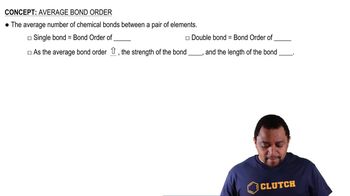
Bond length is the distance between the nuclei of two bonded atoms. Generally, as bond order increases (from single to double to triple bonds), bond length decreases due to increased electron sharing. A single bond has the longest length, while a triple bond has the shortest. Understanding this relationship helps in determining the type of bond based on measured lengths.
Recommended video:
Guided course
Average Bond Order
C—O Bond Characteristics
Carbon-oxygen (C—O) bonds can exist in various forms: single (C—O), double (C=O), and triple (C≡O). Each type has distinct properties, with single bonds being longer and weaker, while double and triple bonds are shorter and stronger. The specific bond length of 120 pm suggests a bond type that is neither too long nor too short, indicating it is likely a single or double bond.
Recommended video:
Guided course
Chemical Bonds Example 2
Comparative Bond Lengths
To assess the bond type, it is useful to compare the given bond length with known values for C—O bonds. A typical C—O single bond is around 143 pm, while a C=O double bond is approximately 120 pm. This comparison allows for a more accurate determination of the bond type in the new compound based on the measured bond length.
Recommended video:
Guided course
Average Bond Order
Related Practice
Textbook Question
882
views
Textbook Question
Consider the lattice energies of the following Group 2A compounds: BeH2, 3205 kJ/mol; MgH2, 2791 kJ/mol; CaH2, 2410 kJ/mol; SrH2, 2250 kJ/mol; BaH2, 2121 kJ/mol. (d) The lattice energy of ZnH2 is 2870 kJ/mol. Considering the trend in lattice enthalpies in the Group 2 compounds, predict which Group 2 element is most similar in ionic radius to the Zn2+ ion.
1
views
Textbook Question
Draw the Lewis structure for NO+ . Is the nitrogen–oxygen bond in NO+ longer, shorter, or the same length as thenitrogen–oxygen bond in NO? Explain.Draw the Lewis structure for NO+ .
1187
views
Textbook Question
Consider the lattice energies of the following Group 2A compounds: BeH2, 3205 kJ/mol; MgH2, 2791 kJ/mol; CaH2, 2410 kJ/mol; SrH2, 2250 kJ/mol; BaH2, 2121 kJ/mol. (c) Consider BeH2. Does it require 3205 kJ of energy to break one mole of the solid into its ions, or does breaking up one mole of solid into its ions release 3205 kJ of energy?
1
views