
Ch.8 - Basic Concepts of Chemical Bonding
Brown - Chemistry: The Central Science 14th Edition
Brown14th EditionChemistry: The Central ScienceISBN: 9780134414232Not the one you use?Change textbook
Chapter 8, Problem 53c

(c) What would you predict for the lengths of the bonds in NO2- relative to N¬O single bonds and double bonds?

Verified step by step guidance
1
Understand the structure of the nitrite ion (NO2-). It consists of a nitrogen atom bonded to two oxygen atoms, with one of these bonds being a double bond and the other a single bond, due to resonance.
Recognize that resonance in NO2- means that the actual structure is a hybrid of the two resonance forms, where the double bond and single bond are averaged over the two N-O bonds.
Recall that in resonance structures, the bond lengths are intermediate between the lengths of a single bond and a double bond. This is because the electron density is delocalized over the entire molecule.
Compare the bond lengths: A typical N-O single bond is longer than a typical N-O double bond. Therefore, the bond lengths in NO2- will be shorter than a single bond but longer than a double bond.
Conclude that the bond lengths in NO2- are equal due to resonance and are intermediate between the lengths of a N-O single bond and a N-O double bond.

Verified video answer for a similar problem:

This video solution was recommended by our tutors as helpful for the problem above.
Video duration:
3m
Was this helpful?

Key Concepts

Here are the essential concepts you must grasp in order to answer the question correctly.

Bond Order

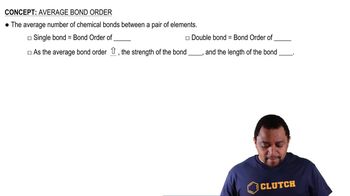
Bond order is a measure of the number of chemical bonds between a pair of atoms. It is calculated as the difference between the number of bonding electrons and the number of antibonding electrons, divided by two. In the case of nitrogen dioxide (NO2) and its anion (NO2-), the bond order helps predict the bond lengths, as higher bond orders typically correlate with shorter bond lengths due to increased electron density between the bonded atoms.
Recommended video:
Guided course
00:36
Average Bond Order

Resonance Structures

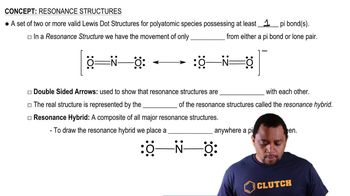
Resonance structures are different ways of drawing the same molecule that illustrate the delocalization of electrons. In NO2-, resonance indicates that the actual structure is a hybrid of these forms, leading to bond lengths that are intermediate between single and double bonds. This concept is crucial for understanding the bond lengths in NO2- as it affects the distribution of electron density and the effective bond order.
Recommended video:
Guided course
01:42
Resonance Structures

Bond Length Trends

Bond length is influenced by the type of bond formed between atoms; single bonds are generally longer than double bonds due to the increased electron sharing in double bonds. In NO2-, the bond lengths can be predicted to be shorter than a typical N-O single bond but longer than a double bond, reflecting the resonance and partial double bond character present in the anion.
Recommended video:
Guided course
00:38
Periodic Trends
Related Practice
Textbook Question

Consider the formate ion, HCO2-, which is the anion formed when formic acid loses an H+ ion. The H and the two O atoms are bonded to the central C atom. (c) Would you predict that the C—O bond lengths in the formate ion would be longer or shorter relative to those in CO2?

1
views
Textbook Question

Predict the ordering, from shortest to longest, of the bond lengths in CO, CO2, and CO32- .

845
views
Textbook Question

Which one of these statements about formal charge is true? (a) Formal charge is the same as oxidation number. (b) To draw the best Lewis structure, you should minimize formal charge. (c) Formal charge takes into account the different electronegativities of the atoms in a molecule. (d) Formal charge is most useful for ionic compounds. (e) Formal charge is used in calculating the dipole moment of a diatomic molecule.

1355
views
Textbook Question

For each of the following molecules or ions of sulfur and oxygen, write a single Lewis structure that obeys the octet rule, and calculate the oxidation numbers and formal charges on all the atoms: (a) SO2 Write a single Lewis structure that obeys the octet rule for SO2 and assign the formal charges on all the atoms. (b) SO3 Write a single Lewis structure that obeys the octet rule for SO3 and assign the formal charges on all the atoms. (c) SO32- Write a single Lewis structure that obeys the octet rule for SO32- and assign the formal charges on all the atoms.

573
views
Textbook Question

Based on Lewis structures, predict the ordering, from shortest to longest, of N¬O bond lengths in NO+, NO2-, and NO3-.

1530
views
1
comments