Using only the periodic table as your guide, select the most electronegative atom in each of the following sets: (a) Se, Te, Br, I; (b) Be, Mg, C, Si (c) Al, Si, P, S (d) Zn, Ge, Ga, As.
Ch.8 - Basic Concepts of Chemical Bonding
Brown14th EditionChemistry: The Central ScienceISBN: 9780134414232Not the one you use?Change textbook
Chapter 8, Problem 35c
(c) Would you expect the O—O bond in O2 to be shorter or longer than the O—O bond in compounds that contain an O—O single bond? Explain.
Verified step by step guidance1
Understand the concept of bond order: Bond order refers to the number of chemical bonds between a pair of atoms. In molecular oxygen (O2), the bond order is 2, indicating a double bond.
Compare bond types: A single bond typically consists of one sigma bond, while a double bond consists of one sigma bond and one pi bond. Double bonds are generally shorter and stronger than single bonds due to the additional pi bond.
Consider the bond length: Bond length is inversely related to bond order. Higher bond order usually results in shorter bond lengths because the atoms are held together more tightly.
Apply this to O2: Since O2 has a double bond (bond order of 2), the O—O bond in O2 is expected to be shorter than the O—O bond in compounds with an O—O single bond (bond order of 1).
Conclude with reasoning: The presence of a pi bond in O2 contributes to a shorter bond length compared to a single bond, which lacks the additional pi bond. Therefore, the O—O bond in O2 is shorter than in compounds with an O—O single bond.

Verified video answer for a similar problem:
This video solution was recommended by our tutors as helpful for the problem above.
Video duration:
1mWas this helpful?
Key Concepts
Here are the essential concepts you must grasp in order to answer the question correctly.
Bond Order
Bond order refers to the number of chemical bonds between a pair of atoms. In the case of O2, the bond order is 2, indicating a double bond, which typically results in a shorter bond length compared to a single bond. Higher bond orders generally lead to stronger and shorter bonds due to increased electron sharing.
Recommended video:
Guided course
Average Bond Order
Bond Length
Bond length is the average distance between the nuclei of two bonded atoms. It is influenced by the type of bond (single, double, or triple) and the size of the atoms involved. In general, double bonds (like in O2) are shorter than single bonds due to the stronger attraction between the bonded atoms.
Recommended video:
Guided course
Average Bond Order
Resonance Structures
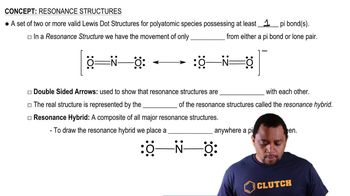
Resonance structures are different ways of drawing the same molecule that show the delocalization of electrons. In compounds with O—O single bonds, resonance can affect bond length and strength. However, in O2, the presence of a double bond means that resonance is not a factor, leading to a more stable and shorter bond compared to single-bonded oxygen compounds.
Recommended video:
Guided course
Resonance Structures
Related Practice
Textbook Question
545
views
Textbook Question
(a) Construct a Lewis structure for hydrogen peroxide, H2O2, in which each atom achieves an octet of electrons.
2
views
Textbook Question
(b) How many bonding electrons are in the structure?
1021
views
Textbook Question
Using Lewis symbols and Lewis structures, diagram the formation of PF3 from P and F atoms, showing valence-shell electrons. (a) How many valence electrons does P have initially? (c) How many valence electrons surround the P in the PF3 molecule? (d) How many valence electrons surround each P in the PF3 molecule?
994
views
Textbook Question
Using Lewis symbols and Lewis structures, diagram the formation of PF3 from P and F atoms, showing valence-shell electrons. (e) Does PF3 obey the octet rule?
554
views