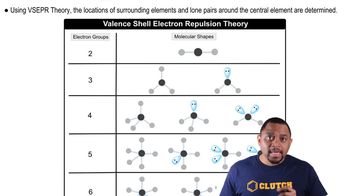
Describe the bond angles to be found in each of the following molecular structures: (a) trigonal planar, (b) tetrahedral, (c) octahedral, (d) linear.
Ch.9 - Molecular Geometry and Bonding Theories
Brown14th EditionChemistry: The Central ScienceISBN: 9780134414232Not the one you use?Change textbook
Chapter 9, Problem 17b
(b) An AB4 molecule has two lone pairs of electrons on the A atom (in addition to the four B atoms). What is the electron-domain geometry around the A atom?
Verified step by step guidance1
Identify the total number of electron domains around the central atom A. This includes both bonding pairs (from the B atoms) and lone pairs on A.
Count the bonding pairs from the four B atoms and the two lone pairs on A. This gives a total of six electron domains around atom A.
Recall that the arrangement of electron domains is determined by minimizing repulsions between them, according to VSEPR theory.
Use the VSEPR model to determine the geometry that accommodates six electron domains. This is typically an octahedral arrangement.
Conclude that the electron-domain geometry around the A atom, considering both bonding pairs and lone pairs, is octahedral.

Verified video answer for a similar problem:
This video solution was recommended by our tutors as helpful for the problem above.
Video duration:
6mWas this helpful?
Key Concepts
Here are the essential concepts you must grasp in order to answer the question correctly.
Electron-Domain Geometry
Electron-domain geometry refers to the spatial arrangement of all electron domains (bonding and lone pairs) around a central atom in a molecule. It helps predict the shape of the molecule based on the number of electron pairs, whether they are involved in bonding or are lone pairs. The geometry is determined using the VSEPR (Valence Shell Electron Pair Repulsion) theory, which states that electron pairs will arrange themselves to minimize repulsion.
VSEPR Theory
VSEPR theory is a model used to predict the geometry of individual molecules based on the number of electron pairs surrounding their central atoms. According to this theory, electron pairs, including lone pairs and bonding pairs, repel each other and will arrange themselves in a way that maximizes the distance between them. This results in specific molecular shapes, such as tetrahedral, trigonal bipyramidal, or octahedral, depending on the number of electron domains.
Recommended video:
Guided course
Molecular Shapes and VSEPR
Lone Pairs and Their Influence
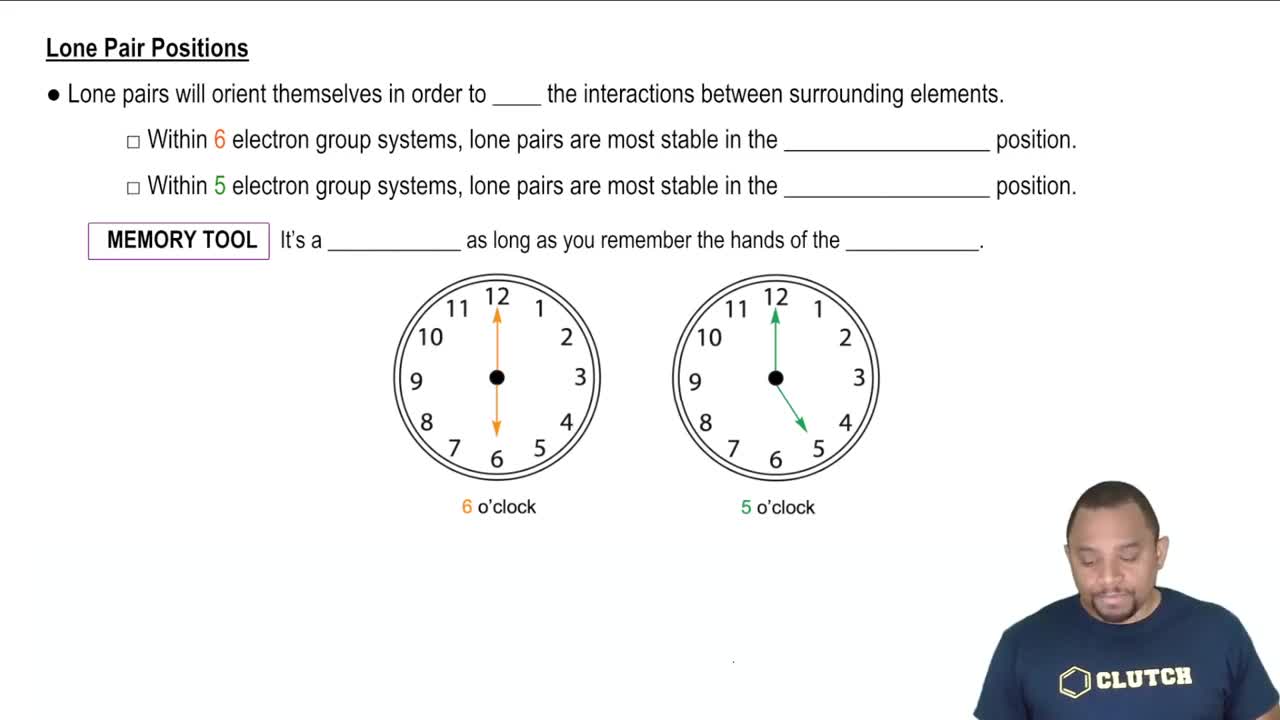
Lone pairs are pairs of valence electrons that are not involved in bonding and are localized on a single atom. They occupy space and exert repulsive forces on other electron domains, influencing the overall geometry of the molecule. In the case of the AB4 molecule with two lone pairs on the A atom, these lone pairs will affect the arrangement of the bonding pairs, leading to a specific electron-domain geometry that differs from that of a molecule with only bonding pairs.
Recommended video:
Guided course
Lone Pair Positions
Related Practice
Textbook Question
1071
views
Textbook Question
(a) An AB6 molecule has no lone pairs of electrons on the A atom. What is its molecular geometry? (c) For the AB4 molecule in part (b), predict the molecular geometry.
Textbook Question
In which of the following molecules can you confidently predict the bond angles about the central atom, and for which would you be a bit uncertain? Explain in each case. (a) H2S, (b) BCl3, (c) CH3I, (d) CBr4, (e) TeBr4.
1245
views
Textbook Question
Would you expect the nonbonding electron-pair domain in NCl3 to be greater or smaller in size than the corresponding one in PCl3?
523
views
Textbook Question
(b) The PCl3 molecule is trigonal pyramidal, while ICl3 is T-shaped. Which of these molecules is flat?
3968
views