In the formate ion, HCO2-, the carbon atom is the central atom with the other three atoms attached to it. (d) How many electrons are in the p system of the ion?
Ch.9 - Molecular Geometry and Bonding Theories
Brown14th EditionChemistry: The Central ScienceISBN: 9780134414232Not the one you use?Change textbook
Chapter 9, Problem 64c
(c) Would you expect N2O to exhibit delocalized p bonding?

Verified step by step guidance1
Step 1: Understand the concept of delocalized π bonding. Delocalized π bonding occurs when π electrons are shared across multiple atoms, rather than being localized between two atoms.
Step 2: Analyze the molecular structure of N2O. The structure shows a nitrogen atom double-bonded to another nitrogen atom, which is in turn double-bonded to an oxygen atom.
Step 3: Identify the presence of π bonds in the molecule. In N2O, there are two π bonds: one between the two nitrogen atoms and one between the nitrogen and oxygen atoms.
Step 4: Determine if the π electrons can be delocalized. For delocalization to occur, the π electrons must be able to move freely across the atoms involved. In N2O, the π electrons are confined to the regions between the nitrogen-nitrogen and nitrogen-oxygen bonds.
Step 5: Conclude whether N2O exhibits delocalized π bonding. Since the π electrons in N2O are not shared across multiple atoms but are localized between specific pairs of atoms, N2O does not exhibit delocalized π bonding.
Key Concepts
Here are the essential concepts you must grasp in order to answer the question correctly.
Delocalized Electrons
Delocalized electrons are electrons that are not confined to a single bond or atom but are spread over several atoms. This occurs in molecules with resonance structures, where the electron density is shared among multiple bonds, leading to increased stability. In the case of N2O, the presence of multiple resonance forms can indicate potential delocalization of p electrons.
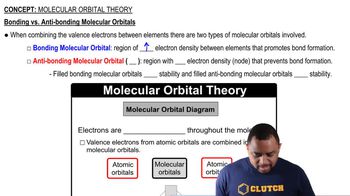
Molecular Orbital Theory
Molecular Orbital Theory describes how atomic orbitals combine to form molecular orbitals that can be occupied by electrons. In this theory, bonding and antibonding orbitals are formed, and electrons can occupy these orbitals, leading to delocalization. Understanding this concept is crucial for analyzing the bonding in N2O and predicting its electronic structure.
Recommended video:
Guided course
Molecular Orbital Theory
Bonding and Antibonding Interactions
Bonding interactions occur when atomic orbitals combine constructively, leading to a lower energy state and stability, while antibonding interactions arise from destructive combinations, resulting in higher energy states. In N2O, the balance between these interactions influences the overall stability and the potential for delocalized p bonding, which can affect the molecule's reactivity and properties.
Recommended video:
Guided course
Bond Order Calculation
Related Practice
Textbook Question
742
views
Textbook Question
(c) Is the p bond in NO2- localized or delocalized?
730
views
1
rank
Textbook Question
In the formate ion, HCO2-, the carbon atom is the central atom with the other three atoms attached to it. (c) Are there multiple equivalent resonance structures for the ion?
1366
views
Textbook Question
(a) Write a single Lewis structure for N2O, and determine the hybridization of the central N atom.
Textbook Question
Consider the Lewis structure shown below.
(a) Does the Lewis structure depict a neutral molecule or an ion? If it is an ion, what is the charge on the ion? What is the charge on the ion
625
views
Textbook Question
Consider the Lewis structure for glycine, the simplest amino acid:
(c) What is the total number of s bonds in the entire molecule, and what is the total number of p bonds?
663
views