
Textbook Question
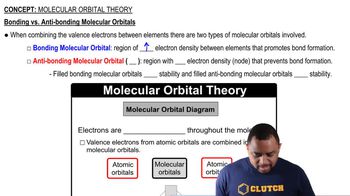
Indicate whether each statement is true or false. (b) The probability is always 0% for finding an electron in an antibonding orbital.

 Verified step by step guidance
 01:53
01:53
 03:06
03:06Indicate whether each statement is true or false. (b) The probability is always 0% for finding an electron in an antibonding orbital.
Indicate whether each statement is true or false. (a) p orbitals can only make σ or σ* molecular orbitals.
(c) Calculate the bond order in H2-.
Draw a picture that shows all three 2p orbitals on one atom and all three 2p orbitals on another atom. (c) How many antibonding orbitals, and of what type can be made from the two sets of 2p orbitals?
Consider the H2+ ion. (f) Which of the following statements about part (e) is correct: (i) The light excites an electron from a bonding orbital to an antibonding orbital, (ii) The light excites an electron from an antibonding orbital to a bonding orbital, or (iii) In the excited state there are more bonding electrons than antibonding electrons?
Consider the H2+ ion. (e) Suppose that the ion is excited by light so that an electron moves from a lower-energy to a higher-energy MO. Would you expect the excited-state H2+ ion to be stable or to fall apart?