
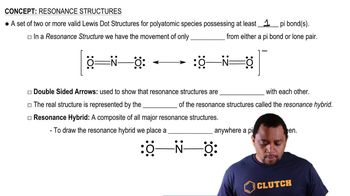
Sodium azide is a shock-sensitive compound that releases N2 upon physical impact. The compound is used in automobile airbags. The azide ion is N3-. (a) Draw the Lewis structure of the azide ion that minimizes formal charge (it does not form a triangle). Is it linear or bent?
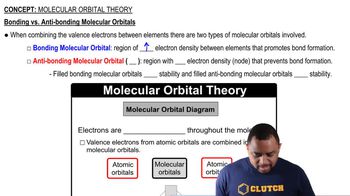
For one of the resonance forms of ozone, O3, which of the orbitals are used to make bonds and which are used to hold nonbonding pairs of electrons?
Verified step by step guidanceKey Concepts
Resonance Structures
Molecular Orbitals
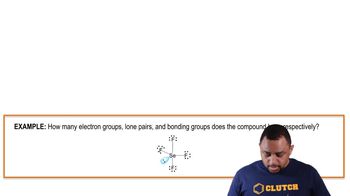
Lone Pairs and Bonding Pairs
Butadiene, C4H6, is a planar molecule that has the following carbon–carbon bond lengths:
(b) From left to right, what is the hybridization of each carbon atom in butadiene?
(b) The anion IO4- has a tetrahedral structure: three oxygen atoms form double bonds with the central iodine atom and one oxygen atom which carries a negative charge forms a single bond. Predict the molecular geometry of IO65-.
Sodium azide is a shock-sensitive compound that releases N2 upon physical impact. The compound is used in automobile airbags. The azide ion is N3-. (b) State the hybridization of the central N atom in the azide ion.
Butadiene, C4H6, is a planar molecule that has the following carbon–carbon bond lengths:
(a) Predict the bond angles around each of the carbon atoms and sketch the molecule.
In ozone, O3, the two oxygen atoms on the ends of the molecule are equivalent to one another. (d) How many electrons are delocalized in the p system of ozone?
