Ch.9 - Molecular Geometry and Bonding Theories
Brown - Chemistry: The Central Science 14th Edition
Brown14th EditionChemistry: The Central ScienceISBN: 9780134414232Not the one you use?Change textbook
Chapter 9, Problem 112b

The energy-level diagram in Figure 9.36 shows that the sideways overlap of a pair of p orbitals produces two molecular orbitals, one bonding and one antibonding. In ethylene there is a pair of electrons in the bonding π orbital between the two carbons. Absorption of a photon of the appropriate wavelength can result in promotion of one of the bonding electrons from the p2p to the p*2p molecular orbital. (b) Assuming this electronic transition corresponds to the HOMO-LUMO transition, what is the LUMO in ethylene?
Energy-level diagram showing bonding and antibonding molecular orbitals from 1s orbitals.

Verified step by step guidance
1
Identify the Highest Occupied Molecular Orbital (HOMO) in ethylene, which is the bonding π orbital formed by the sideways overlap of p orbitals.
Determine the Lowest Unoccupied Molecular Orbital (LUMO) in ethylene, which is the antibonding π* orbital formed by the sideways overlap of p orbitals.
Understand that the HOMO-LUMO transition involves an electron being excited from the HOMO (bonding π orbital) to the LUMO (antibonding π* orbital).
Recognize that the LUMO in ethylene is the π*2p molecular orbital.
Conclude that the LUMO in ethylene is the antibonding π* orbital formed by the sideways overlap of the p orbitals.

Verified video answer for a similar problem:

This video solution was recommended by our tutors as helpful for the problem above.
Video duration:
1m
Was this helpful?

Key Concepts

Here are the essential concepts you must grasp in order to answer the question correctly.

Molecular Orbitals

Molecular orbitals (MOs) are formed when atomic orbitals combine during the bonding process. In the case of ethylene, the sideways overlap of p orbitals creates two types of MOs: bonding and antibonding. The bonding molecular orbital (π) is lower in energy and stabilizes the molecule, while the antibonding molecular orbital (π*) is higher in energy and destabilizes it. Understanding these orbitals is crucial for analyzing electronic transitions in molecules.
Recommended video:
Guided course
03:06
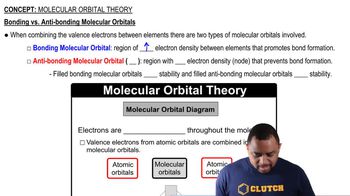
Molecular Orbital Theory

HOMO and LUMO

The Highest Occupied Molecular Orbital (HOMO) and the Lowest Unoccupied Molecular Orbital (LUMO) are key concepts in molecular orbital theory. The HOMO is the highest energy orbital that contains electrons, while the LUMO is the lowest energy orbital that is empty. The transition of an electron from the HOMO to the LUMO upon photon absorption is fundamental in understanding the electronic properties of molecules, such as their reactivity and color.

Electronic Transitions

Electronic transitions refer to the movement of electrons between different energy levels or orbitals within a molecule. In ethylene, the absorption of a photon can promote an electron from the bonding π orbital (HOMO) to the antibonding π* orbital (LUMO). This transition is significant in spectroscopy and photochemistry, as it can lead to various chemical reactions and changes in molecular properties, such as color and stability.
Recommended video:
Guided course
00:53
Electron Configurations Of Transition Metals Example