Show how Equations 18.7 and 18.9 can be added to give Equation 18.10.
Ch.18 - Chemistry of the Environment
Brown14th EditionChemistry: The Central ScienceISBN: 9780134414232Not the one you use?Change textbook
Chapter 18, Problem 68
Explain, using Le Châtelier’s principle, why the equilibrium constant for the formation of NO from N2 and O2 increases with increasing temperature, whereas the equilibrium constant for the formation of NO2 from NO and O2 decreases with increasing temperature.
Verified step by step guidance1
Step 1: Identify the reactions involved. The formation of NO from N2 and O2 is represented by the reaction: N2(g) + O2(g) ⇌ 2NO(g). The formation of NO2 from NO and O2 is represented by the reaction: 2NO(g) + O2(g) ⇌ 2NO2(g).
Step 2: Determine the enthalpy change (ΔH) for each reaction. The formation of NO is an endothermic reaction (ΔH > 0), meaning it absorbs heat. The formation of NO2 is an exothermic reaction (ΔH < 0), meaning it releases heat.
Step 3: Apply Le Châtelier’s principle to the formation of NO. Since the reaction is endothermic, increasing the temperature will shift the equilibrium to the right, favoring the formation of more NO, thus increasing the equilibrium constant (K).
Step 4: Apply Le Châtelier’s principle to the formation of NO2. Since the reaction is exothermic, increasing the temperature will shift the equilibrium to the left, favoring the formation of reactants (NO and O2), thus decreasing the equilibrium constant (K).
Step 5: Summarize the effect of temperature on equilibrium constants. For endothermic reactions, increasing temperature increases K, while for exothermic reactions, increasing temperature decreases K, as predicted by Le Châtelier’s principle.
Key Concepts
Here are the essential concepts you must grasp in order to answer the question correctly.
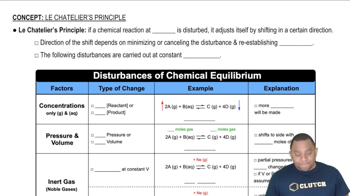
Le Châtelier’s Principle
Le Châtelier’s principle states that if a dynamic equilibrium is disturbed by changing the conditions, the position of equilibrium shifts to counteract the change. This principle helps predict how a system at equilibrium responds to changes in concentration, temperature, or pressure, allowing us to understand the effects of these changes on the equilibrium constant.
Recommended video:
Guided course
Le Chatelier's Principle
Equilibrium Constant (K)
The equilibrium constant (K) is a numerical value that expresses the ratio of the concentrations of products to reactants at equilibrium for a given reaction at a specific temperature. It provides insight into the extent of a reaction and how it shifts in response to changes in conditions, such as temperature, which can favor either the forward or reverse reaction.
Recommended video:
Guided course
Equilibrium Constant K
Endothermic and Exothermic Reactions
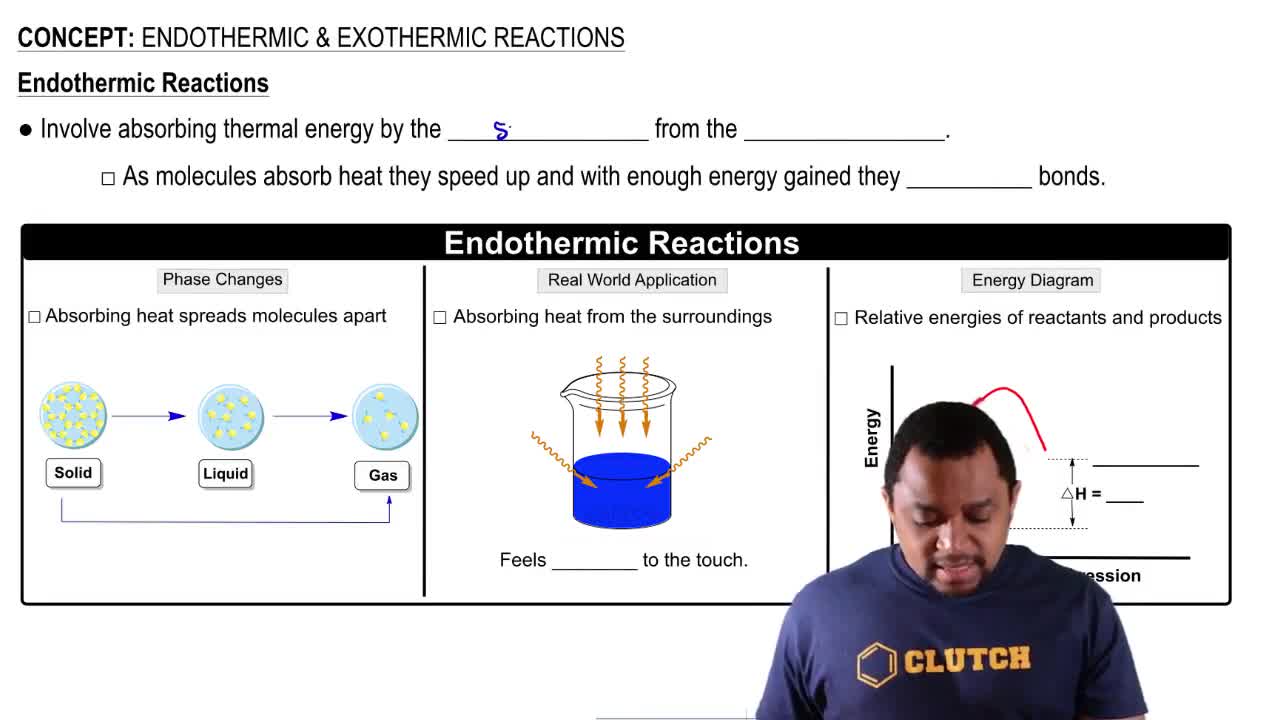
Reactions can be classified as endothermic or exothermic based on their heat exchange with the surroundings. Endothermic reactions absorb heat, and increasing temperature shifts the equilibrium to favor product formation, increasing K. Conversely, exothermic reactions release heat, and raising the temperature shifts the equilibrium towards reactants, decreasing K.
Recommended video:
Guided course
Endothermic & Exothermic Reactions
Related Practice
Textbook Question
448
views
Textbook Question
One of the possible consequences of climate change is an increase in the temperature of ocean water. The oceans serve as a 'sink' for CO2 by dissolving large amounts of it.
(a) The figure below shows the solubility of CO2 in water as a function of temperature. Does CO2 behave more or less similarly to other gases in this respect?
378
views
Textbook Question
Natural gas consists primarily of methane, CH4(g). (a) Write balanced chemical equation for the complete combustion of methane to produce CO2(g) as the only carbon-containing product.
Textbook Question
Natural gas consists primarily of methane, CH4(g). (b) Write a balanced chemical equation for the incomplete combustion of methane to product CO(g) as the only carbon-containg product.
617
views