
Ch.1 - Introduction: Matter, Energy, and Measurement
Brown - Chemistry: The Central Science 15th Edition
Brown15th EditionChemistry: The Central ScienceISBN: 9780137542970Not the one you use?Change textbook
Chapter 1, Problem 45e

What is the number of significant figures in each of the following measured quantities? e. 3.50×103 cm3

Verified step by step guidance
1
Identify the significant figures in the number 3.50.
Recognize that all non-zero digits are significant.
Note that zeros between non-zero digits are also significant.
Understand that zeros to the right of a decimal point and at the end of a number are significant.
Conclude that the number 3.50 has three significant figures.

Key Concepts

Here are the essential concepts you must grasp in order to answer the question correctly.

Significant Figures

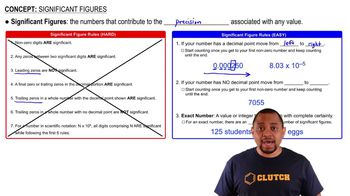
Significant figures are the digits in a number that contribute to its precision. This includes all non-zero digits, any zeros between significant digits, and trailing zeros in the decimal portion. Understanding significant figures is crucial for accurately reporting measurements and ensuring that calculations reflect the precision of the data.
Recommended video:
Guided course
01:09
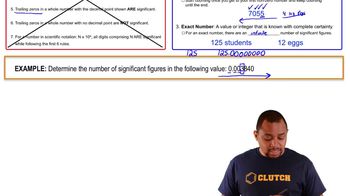
Significant Figures Example

Scientific Notation

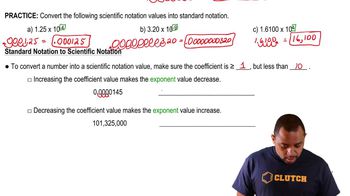
Scientific notation is a way of expressing numbers that are too large or too small to be conveniently written in decimal form. It is represented as a product of a number between 1 and 10 and a power of ten. For example, 3.50×10³ cm³ indicates that the number 3.50 is multiplied by 1000, which helps in identifying significant figures more easily.
Recommended video:
Guided course
02:50
Standard Notation to Scientific Notation

Rules for Counting Significant Figures

There are specific rules for counting significant figures in a number. For instance, all non-zero digits are significant, any zeros between significant digits are significant, and trailing zeros in a decimal number are also significant. Applying these rules helps determine the number of significant figures in a measurement, which is essential for scientific accuracy.
Recommended video:
Guided course
04:40
Significant Figures Rules
Related Practice
Textbook Question

For January through April 2020, at the height of the global coronavirus pandemic, it is estimated that global emissions of carbon dioxide (CO2) decreased by 940 million metric tons (1 metric ) compared to the same period in 2019. a. Express this mass of CO2 in grams without exponential notation, using an appropriate metric prefix.

2
views
Textbook Question

Carry out the following operations and express the answers with the appropriate number of significant numbers. (a) 14.3505 + 2.65 (b) 952.72 - 73.4201

550
views
Textbook Question

(a) The diameter of Earth at the equator is 7926.381 mi. Round this number to three significant figures and express it in standard exponential notation.

901
views
Textbook Question

Indicate which of the following are exact numbers: (a) the mass of a 32-oz bag of sugar, (b) the number of students in your chemistry class, (c) the temperature of the surface of the Sun, (d) the mass of a postage stamp, (e) the number of milliliters in a cubic meter of water, (f) the average height of NBA basketball players.

3
views
Textbook Question

Indicate the number of significant figures in each of the following measured quantities: e. 12.8690 g

2
views
Textbook Question

Indicate which of the following are exact numbers: (a) the mass of a 3- by 5-in. index card, (b) the number of ounces in a pound, (c) the volume of a cup of Seattle's Best coffee, (d) the number of inches in a mile, (e) the number of microseconds in a week, (f) the number of pages in this book.

958
views