
Ch.1 - Introduction: Matter, Energy, and Measurement
Brown - Chemistry: The Central Science 15th Edition
Brown15th EditionChemistry: The Central ScienceISBN: 9780137542970Not the one you use?Change textbook
Chapter 1, Problem 69b

Classify each of the following as a pure substance, a solution, or a heterogeneous mixture: b. a cup of coffee

Verified step by step guidance
1
Understand the definitions: A pure substance has a uniform and definite composition, a solution is a homogeneous mixture where the components are uniformly distributed, and a heterogeneous mixture has visibly different substances or phases.
Consider the composition of a cup of coffee: It typically contains water, dissolved coffee compounds, and possibly other ingredients like sugar or milk.
Determine if the components are uniformly distributed: In a typical cup of black coffee, the dissolved coffee compounds are evenly distributed throughout the liquid.
Evaluate if there are any visible different substances or phases: In black coffee, there are no visible separate phases; it appears uniform throughout.
Classify the cup of coffee: Since the components are uniformly distributed and there are no visible different phases, a cup of black coffee is best classified as a solution.

Verified video answer for a similar problem:

This video solution was recommended by our tutors as helpful for the problem above.
Video duration:
2m
Was this helpful?

Key Concepts

Here are the essential concepts you must grasp in order to answer the question correctly.

Pure Substance

A pure substance consists of a single type of particle and has a uniform composition throughout. It can be an element, like oxygen, or a compound, like water. Pure substances have consistent physical and chemical properties, making them distinct from mixtures.
Recommended video:
Guided course
02:58
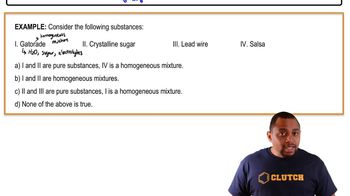
Classification of Matter Example

Solution

A solution is a homogeneous mixture where one substance (the solute) is dissolved in another (the solvent). The components of a solution are evenly distributed at the molecular level, resulting in a single phase. An example is saltwater, where salt is completely dissolved in water.

Heterogeneous Mixture

A heterogeneous mixture contains two or more substances that remain distinct and can be physically separated. The components are not uniformly distributed, leading to different phases or layers. An example is a salad, where the individual ingredients can be seen and separated.
Related Practice
Textbook Question

Two students determine the percentage of iron in a sample as a laboratory exercise. The true percentage is 34.43%. The students’ results for three determinations are as follows: 1. 34.44, 34.41, 34.46 2. 34.51, 34.56, 34.48 b. Precision can be judged by examining the average of the deviations from the average value for that data set. (Calculate the average value for each data set; then calculate the average value of the absolute deviations of each measurement from the average.) Which set is more precise?

2
views
Textbook Question

(b) A(n) _________ reliably predicts the behavior of matter, while a(n) _________ provides an explanation for that behavior.

605
views
Textbook Question

Classify each of the following as a pure substance, a solution, or a heterogeneous mixture: c. a wood plank

4
views
Textbook Question

A copper refinery produces a copper ingot weighing 150 lb. If the copper is drawn into wire whose diameter is 7.50 mm, how many feet of copper can be obtained from the ingot? The density of copper is 8.94 g/cm3. (Assume that the wire is a cylinder whose volume 𝑉=𝜋𝑟2ℎ, where r is its radius and h is its height or length.)

2
views
Textbook Question

Gold can be hammered into extremely thin sheets called gold leaf. An architect wants to cover a 100 ft x 82 ft ceiling with gold leaf that is five-millionths of an inch thick. The density of gold is 19.32 g/cm3. If gold costs \$1768 per troy ounce (1 troy ounce = 31.10348 g), how much will it cost the architect to buy the necessary gold?

3
views