
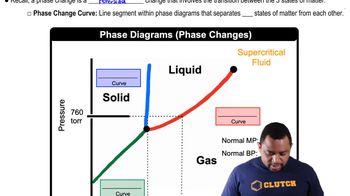
(b) Carbon dioxide (CO2) is a gas at room temperature and pressure. However, carbon dioxide can be put under pressure to become a 'supercritical fluid' that is a much safer dry-cleaning agent than tetrachloroethylene. At a certain pressure, the density of supercritical CO2 is 0.469 g/cm3. What is the mass of a 25.0-mL sample of supercritical CO2 at this pressure?
Ch.1 - Introduction: Matter, Energy, and Measurement

Brown15th EditionChemistry: The Central ScienceISBN: 9780137542970Not the one you use?Change textbook
Chapter 1, Problem 37a
(a) A sample of tetrachloroethylene, a liquid used in dry cleaning that is being phased out because of its potential to cause cancer, has a mass of 40.55 g and a volume of 25.0 mL at 25 °C. What is its density at this temperature? Will tetrachloroethylene float on water? (Materials that are less dense than water will float.)
Verified step by step guidance1
Step 1: Understand the formula for density. Density (\( \rho \)) is defined as mass (\( m \)) divided by volume (\( V \)). The formula is \( \rho = \frac{m}{V} \).
Step 2: Identify the given values in the problem. The mass of tetrachloroethylene is 40.55 g, and the volume is 25.0 mL.
Step 3: Substitute the given values into the density formula. Use \( \rho = \frac{40.55 \text{ g}}{25.0 \text{ mL}} \).
Step 4: Calculate the density using the substituted values. This will give you the density of tetrachloroethylene in g/mL.
Step 5: Compare the calculated density of tetrachloroethylene to the density of water, which is approximately 1.00 g/mL at 25 °C. If the density of tetrachloroethylene is less than 1.00 g/mL, it will float on water; otherwise, it will sink.
Key Concepts
Here are the essential concepts you must grasp in order to answer the question correctly.
Density
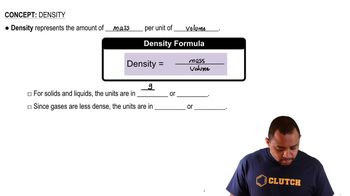
Density is defined as the mass of a substance divided by its volume, typically expressed in grams per milliliter (g/mL) for liquids. It is a crucial property that helps determine how substances interact with each other, particularly whether they will float or sink in a given medium, such as water.
Recommended video:
Guided course
Density Concepts
Buoyancy
Buoyancy refers to the ability of an object to float in a fluid, which is determined by the object's density relative to the fluid's density. An object will float if it is less dense than the fluid it is placed in; conversely, it will sink if it is denser. This principle is essential for understanding the behavior of tetrachloroethylene in water.
Phase-out of Chemicals
The phase-out of chemicals like tetrachloroethylene is often driven by health and environmental concerns, particularly their potential carcinogenic effects. Understanding the implications of using such substances is important in chemistry, as it relates to safety regulations and the search for safer alternatives in industrial applications.
Recommended video:
Guided course
Phase Changes in Diagrams
Related Practice
Textbook Question
1664
views
Textbook Question
Make the following conversions: f. 0 K to °F
2
views
Textbook Question
Many scientific data are reported at 25 °C. What is this temperature in kelvins and in degrees Fahrenheit?
2
views
Textbook Question
b. An experiment requires 78.1 g of benzene, a liquid whose density is 0.876 g/mL. Rather than weigh the sample on a balance, a chemist chooses to dispense the liquid using a graduated cylinder. What volume of the liquid should he use?
3
views
Textbook Question
The temperature on a warm summer day is 87 °F. What is the temperature in °C?
2
views
Textbook Question
c. A cubic piece of metal measures 5.00 cm on each edge. If the metal is nickel, whose density is 8.90 g/cm3, what is the mass of the cube?
3
views
