
a. After the label fell off a bottle containing a clear liquid believed to be a solvent called tetrahydrofuran, a chemist measured the density of the liquid to verify its identity. A 25.0-mL portion of the liquid had a mass of 22.08 g. A chemistry handbook lists the density of tetrahydrofuran at 25 °C as 0.8833 g/mL. Is the calculated density in agreement with the tabulated value?

(d) A cubic piece of metal measures 5.00 cm on each edge. If the metal is nickel, whose density is 8.90 g/cm3, what is the mass of the cube?
Verified step by step guidance
Verified video answer for a similar problem:
Key Concepts
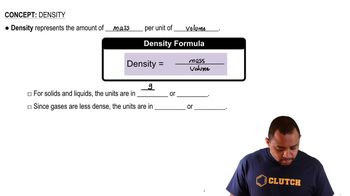
Density
Volume of a Cube
Mass Calculation
(b) Carbon dioxide (CO2) is a gas at room temperature and pressure. However, carbon dioxide can be put under pressure to become a 'supercritical fluid' that is a much safer dry-cleaning agent than tetrachloroethylene. At a certain pressure, the density of supercritical CO2 is 0.469 g/cm3. What is the mass of a 25.0-mL sample of supercritical CO2 at this pressure?
b. An experiment requires 50.0 g of a substance called n-hexane, whose density at 25 °C is 0.6606 g/mL. What volume of n-hexane should be used?
b. An experiment requires 78.1 g of benzene, a liquid whose density is 0.876 g/mL. Rather than weigh the sample on a balance, a chemist chooses to dispense the liquid using a graduated cylinder. What volume of the liquid should he use?
The density of titanium metal is 4.506 g/cm3 at 20 °C. What is the mass of a spherical ball of titanium with a diameter of 2.00 cm. [The volume of a sphere is (4/3) πr3, where r is the radius.]
c. A cubic piece of metal measures 5.00 cm on each edge. If the metal is nickel, whose density is 8.90 g/cm3, what is the mass of the cube?
