Ch.1 - Introduction: Matter, Energy, and Measurement
Brown - Chemistry: The Central Science 15th Edition
Brown15th EditionChemistry: The Central ScienceISBN: 9780137542970Not the one you use?Change textbook
Chapter 1, Problem 97d

Judge the following statements as true or false. If you believe a statement to be false, provide a corrected version. (d) Elements can exist in any of the three states of matter.

Verified step by step guidance
1
Identify the three states of matter: solid, liquid, and gas.
Consider examples of elements that exist in each state at room temperature: solid (e.g., iron), liquid (e.g., mercury), and gas (e.g., oxygen).
Recognize that elements can change states under different conditions of temperature and pressure.
Evaluate the statement: Elements can exist in any of the three states of matter.
Conclude that the statement is true, as elements can exist as solids, liquids, or gases depending on the conditions.

Verified video answer for a similar problem:

This video solution was recommended by our tutors as helpful for the problem above.
Video duration:
2m
Was this helpful?

Key Concepts

Here are the essential concepts you must grasp in order to answer the question correctly.

States of Matter

The states of matter refer to the distinct forms that different phases of matter take on. The three primary states are solid, liquid, and gas, each characterized by different properties such as shape, volume, and particle arrangement. Understanding these states is crucial for analyzing how elements behave under various conditions.

Elemental Properties

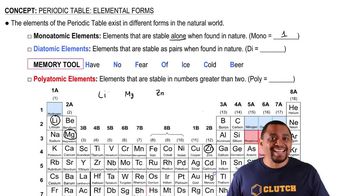
Elements are pure substances that consist of only one type of atom and can exist in different states of matter depending on temperature and pressure. For example, at room temperature, many elements like oxygen exist as gases, while others like mercury are liquids. Recognizing how elements transition between states is essential for understanding their physical properties.
Recommended video:
Guided course
02:35
Elemental Forms of Elements

Phase Changes

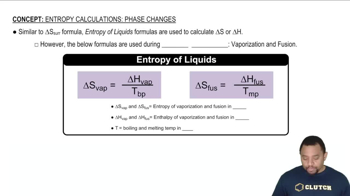
Phase changes are transformations between different states of matter, such as melting, freezing, condensation, and evaporation. These changes occur due to variations in temperature and pressure, affecting the energy and arrangement of particles. Understanding phase changes helps explain how elements can exist in multiple states under different environmental conditions.
Recommended video:
Guided course
01:46
Entropy in Phase Changes
Related Practice
Textbook Question

Judge the following statements as true or false. If you believe a statement to be false, provide a corrected version. (i) Compounds always contain at least two different elements.

629
views

Textbook Question

Judge the following statements as true or false. If you believe a statement to be false, provide a corrected version. (g) The number 0.0033 has more significant figures than 0.033.

394
views
Textbook Question

Judge the following statements as true or false. If you believe a statement to be false, provide a corrected version. (b) All mixtures contain at least one element and one compound.

913
views
Textbook Question

Judge the following statements as true or false. If you believe a statement to be false, provide a corrected version. (a) Air and water are both elements.

590
views
Textbook Question

You are assigned the task of separating a desired granular material with a density of 3.62 g/cm3 from an undesired granular material that has a density of 2.04 g/cm3. You want to do this by shaking the mixture in a liquid in which the heavier material will fall to the bottom and the lighter material will float. A solid will float on any liquid that is more dense. Using an Internet-based source or a handbook of chemistry, find the densities of the following substances: carbon tetrachloride, hexane, benzene, and diiodomethane. Which of these liquids will serve your purpose, assuming no chemical interaction takes place between the liquid and the solids?

724
views
Textbook Question

Judge the following statements as true or false. If you believe a statement to be false, provide a corrected version. (c) Compounds can be decomposed into two or more other substances; elements cannot.

584
views