
Magnesium can be used as a “getter” in evacuated enclosures to react with the last traces of oxygen. (The magnesium is usually heated by passing an electric current through a wire or ribbon of the metal.) If an enclosure of 0.452 L has a partial pressure of O2 of 3.5×10⁻⁶ torr at 27°C, what mass of magnesium will react according to the following equation?

In the Dumas-bulb technique for determining the molar mass of an unknown liquid, you vaporize the sample of a liquid that boils below 100°C in a boiling-water bath and determine the mass of vapor required to fill the bulb. From the following data, calculate the molar mass of the unknown liquid: mass of unknown vapor, 1.012 g; volume of bulb, 354 cm3; pressure, 742 torr; temperature, 99°C.
Verified step by step guidance
Verified video answer for a similar problem:
Key Concepts
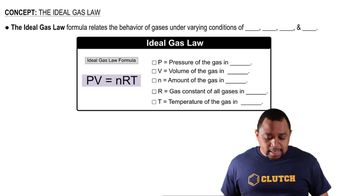
Ideal Gas Law
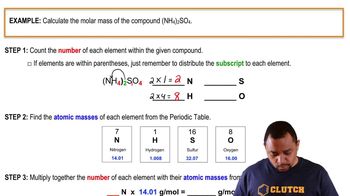
Molar Mass Calculation
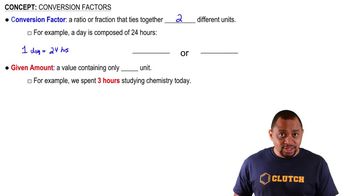
Conversions and Units
Which of the following statements best explains why a closed balloon filled with helium gas rises in air? (a) Helium is a monatomic gas, whereas nearly all the molecules that make up air, such as nitrogen and oxygen, are diatomic. (b) The average speed of helium atoms is greater than the average speed of air molecules, and the greater speed of collisions with the balloon walls propels the balloon upward. (c) Because the helium atoms are of lower mass than the average air molecule, the helium gas is less dense than air. The mass of the balloon is thus less than the mass of the air displaced by its volume. (d) Because helium has a lower molar mass than the average air molecule, the helium atoms are in faster motion. This means that the temperature of the helium is greater than the air temperature. Hot gases tend to rise.
(a) Calculate the density of NO2 gas at 0.970 atm and 35 °C.
Calcium hydride, CaH2, reacts with water to form hydrogen gas:
CaH2(𝑠)+2 H2O(𝑙)⟶Ca(OH)2(𝑎𝑞)+2 H2(𝑔)
This reaction is sometimes used to inflate life rafts, weather balloons, and the like, when a simple, compact means of generating H2 is desired. How many grams of CaH2 are needed to generate 145 L of H2 gas if the pressure of H2 is 825 torr at 21°C?
Calculate the molar mass of a vapor that has a density of 7.135 g/L at 12°C and 743 torr.
