Ch.10 - Gases
Brown - Chemistry: The Central Science 15th Edition
Brown15th EditionChemistry: The Central ScienceISBN: 9780137542970Not the one you use?Change textbook
Chapter 10, Problem 44b

Many gases are shipped in high-pressure containers. Consider a steel tank whose volume is 55.0 gallons that contains O2 gas at a pressure of 16,500 kPa at 23°C. b. What volume would the gas occupy at STP?

Verified step by step guidance
1
1. First, we need to convert the volume from gallons to liters because the standard volume unit in chemistry is liters. We know that 1 gallon is approximately 3.78541 liters. So, multiply 55.0 gallons by 3.78541 to get the volume in liters.
2. Next, we need to convert the temperature from Celsius to Kelvin because the standard temperature unit in chemistry is Kelvin. We know that Kelvin = Celsius + 273.15. So, add 273.15 to 23°C to get the temperature in Kelvin.
3. Now, we can use the ideal gas law equation, which is PV = nRT, where P is the pressure, V is the volume, n is the number of moles, R is the ideal gas constant, and T is the temperature. However, since we are comparing the same gas under two different conditions, we can use the combined gas law equation, which is (P1V1)/T1 = (P2V2)/T2, where the subscripts 1 and 2 refer to the initial and final conditions, respectively.
4. We know the initial pressure (P1), volume (V1), and temperature (T1), and we want to find the final volume (V2) at standard temperature and pressure (STP). STP is defined as a temperature of 273.15 K and a pressure of 1.00 atm. However, since the pressure is given in kPa, we need to convert 1.00 atm to kPa. We know that 1.00 atm is approximately 101.325 kPa.
5. Substitute the known values into the combined gas law equation and solve for V2. This will give you the volume of the gas at STP.

Verified video answer for a similar problem:

This video solution was recommended by our tutors as helpful for the problem above.
Video duration:
2m
Was this helpful?

Key Concepts

Here are the essential concepts you must grasp in order to answer the question correctly.

Ideal Gas Law

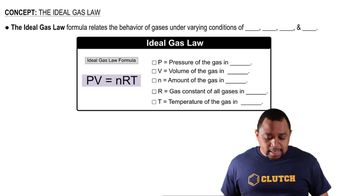
The Ideal Gas Law relates the pressure, volume, temperature, and number of moles of a gas through the equation PV = nRT. This law is essential for understanding how gases behave under different conditions and allows for calculations involving changes in state, such as volume at standard temperature and pressure (STP).
Recommended video:
Guided course
01:15
Ideal Gas Law Formula

Standard Temperature and Pressure (STP)

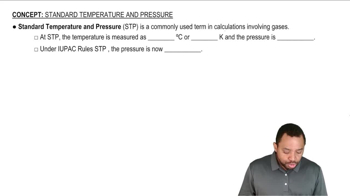
STP is defined as a temperature of 0°C (273.15 K) and a pressure of 1 atm (101.3 kPa). At STP, one mole of an ideal gas occupies a volume of 22.4 liters. Understanding STP is crucial for converting gas volumes from one set of conditions to another, particularly in stoichiometric calculations.
Recommended video:
Guided course
01:08
Standard Temperature and Pressure

Gas Volume Conversion

Gas volume conversion involves using the Ideal Gas Law and STP conditions to determine how the volume of a gas changes with variations in pressure and temperature. This concept is vital for solving problems that require finding the volume of a gas under different conditions, such as from high-pressure states to STP.
Related Practice
Textbook Question

Many gases are shipped in high-pressure containers. Consider a steel tank whose volume is 55.0 gallons that contains O2 gas at a pressure of 16,500 kPa at 23°C. c. At what temperature would the pressure in the tank equal 150.0 atm?

Textbook Question

Chlorine is widely used to purify municipal water supplies and to treat swimming pool waters. Suppose that the volume of a particular sample of Cl2 gas is 8.70 L at 895 torr and 24°C. c. At what temperature will the volume be 15.00 L if the pressure is 8.76×10² torr?

Textbook Question

Chlorine is widely used to purify municipal water supplies and to treat swimming pool waters. Suppose that the volume of a particular sample of Cl2 gas is 8.70 L at 895 torr and 24°C. b. What volume will the Cl2 occupy at STP?

Textbook Question

The physical fitness of athletes is measured by 'VO2 max,' which is the maximum volume of oxygen consumed by an individual during incremental exercise (for example, on a treadmill). An average male has a VO2 max of 45 mL O2/kg body mass/min, but a world-class male athlete can have a VO2 max reading of 88.0 mL O2/kg body mass/min. (a) Calculate the volume of oxygen, in mL, consumed in 1 hr by an average man who weighs 85 kg and has a VO2 max reading of 47.5 mL O2/kg body mass/min. (b) If this man lost 10 kg, exercised, and increased his VO2 max to 65.0 mL O2/kg body mass/min, how many mL of oxygen would he consume in 1 hr?

981
views
Textbook Question

Many gases are shipped in high-pressure containers. Consider a steel tank whose volume is 55.0 gallons that contains O2 gas at a pressure of 16,500 kPa at 23°C. d. What would be the pressure of the gas, in kPa, if it were transferred to a container at 24°C whose volume is 55.0 L?

Textbook Question

A 334-mL cylinder for use in chemistry lectures contains 5.225 g of helium at 23°C. How many grams of helium must be released to reduce the pressure to 75 atm assuming ideal-gas behavior?