
Ch.10 - Gases
Brown - Chemistry: The Central Science 15th Edition
Brown15th EditionChemistry: The Central ScienceISBN: 9780137542970Not the one you use?Change textbook
Chapter 10, Problem 92b

Calculate the pressure that CCl4 will exert at 80 °C if 1.00 mol occupies 33.3 L, assuming that (a) CCl4 obeys the ideal-gas equation (b) CCl4 obeys the van der Waals equation. (Values for the van der Waals constants are given in Table 10.3.)

Verified step by step guidance
1
Convert the temperature from Celsius to Kelvin by adding 273.15 to the given temperature (80 °C).
Use the ideal gas law equation, \( PV = nRT \), where \( P \) is pressure, \( V \) is volume, \( n \) is the number of moles, \( R \) is the ideal gas constant (0.0821 L·atm/mol·K), and \( T \) is the temperature in Kelvin, to calculate the pressure assuming CCl4 behaves as an ideal gas.
For the van der Waals equation, use the formula \( \left( P + \frac{an^2}{V^2} \right)(V - nb) = nRT \), where \( a \) and \( b \) are the van der Waals constants for CCl4. Substitute the known values into this equation.
Solve the van der Waals equation for pressure \( P \) by rearranging the terms and substituting the values for \( a \), \( b \), \( n \), \( V \), and \( T \).
Compare the pressures obtained from the ideal gas law and the van der Waals equation to understand the effect of intermolecular forces and molecular volume on the behavior of CCl4.

Key Concepts

Here are the essential concepts you must grasp in order to answer the question correctly.

Ideal Gas Law

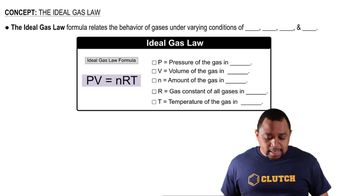
The Ideal Gas Law is a fundamental equation in chemistry that relates the pressure, volume, temperature, and number of moles of a gas. It is expressed as PV = nRT, where P is pressure, V is volume, n is the number of moles, R is the ideal gas constant, and T is temperature in Kelvin. This law assumes that gas particles do not interact and occupy no volume, making it applicable under many conditions but not all.
Recommended video:
Guided course
01:15
Ideal Gas Law Formula

Van der Waals Equation

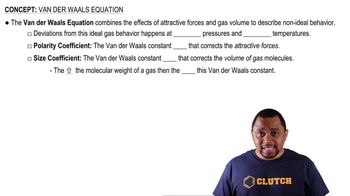
The Van der Waals equation is an adjustment of the Ideal Gas Law that accounts for the volume occupied by gas molecules and the attractive forces between them. It is expressed as (P + a(n/V)²)(V - nb) = nRT, where 'a' and 'b' are constants specific to each gas. This equation provides a more accurate description of real gas behavior, especially at high pressures and low temperatures, where deviations from ideality are significant.
Recommended video:
Guided course
01:40
Van der Waals Equation

Pressure Units and Conversion

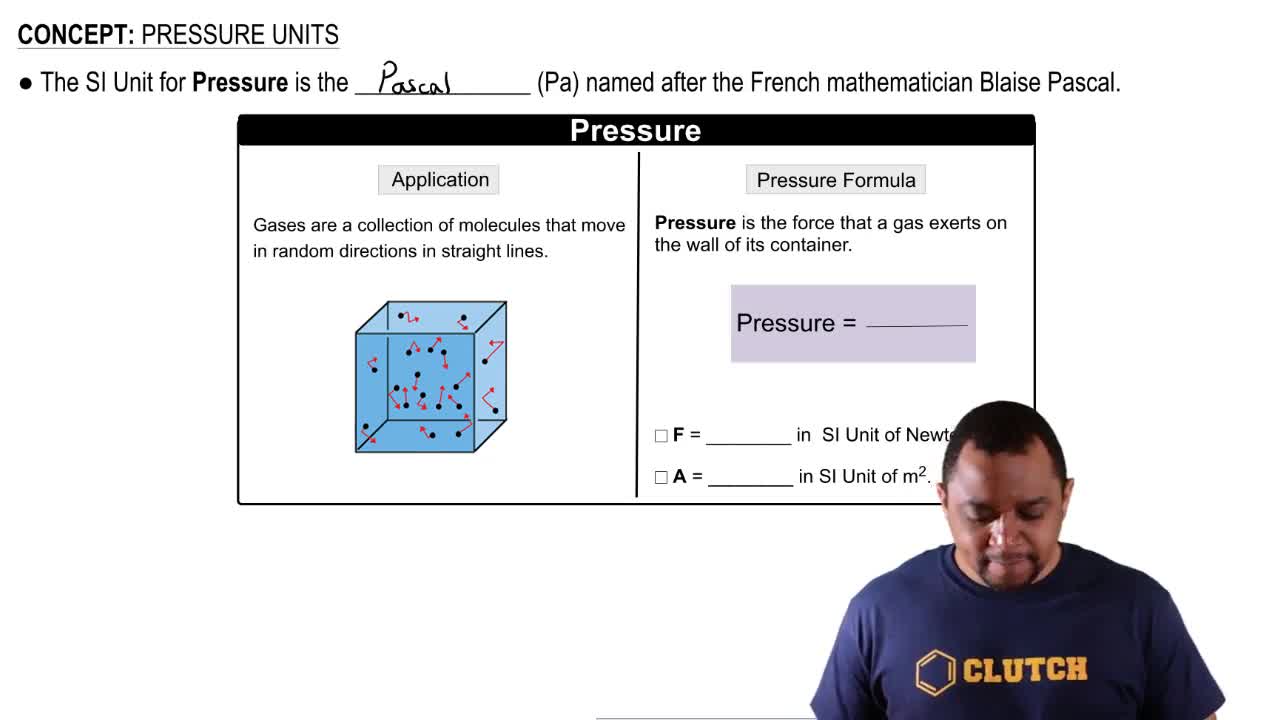
Pressure is a measure of force exerted per unit area and is commonly expressed in units such as atmospheres (atm), pascals (Pa), or mmHg. In calculations involving gases, it is crucial to ensure that pressure is in the correct units that correspond with the other variables in the gas equations. Conversions may be necessary, for example, converting mmHg to atm by using the conversion factor 1 atm = 760 mmHg.
Recommended video:
Guided course
01:15
Pressure Units
Related Practice
Textbook Question

A gas of unknown molecular mass was allowed to effuse through a small opening under constant-pressure conditions. It required 105 s for 1.0 L of the gas to effuse. Under identical experimental conditions it required 31 s for 1.0 L of O2 gas to effuse. Calculate the molar mass of the unknown gas. (Remember that the faster the rate of effusion, the shorter the time required for effusion of 1.0 L; in other words, rate is the amount that diffuses over the time it takes to diffuse.)

1825
views
Textbook Question

The planet Jupiter has a surface temperature of 140 K and a mass 318 times that of Earth. Mercury (the planet) has a surface temperature between 600 K and 700 K and a mass 0.05 times that of Earth. On which planet is the atmosphere more likely to obey the ideal-gas law? Explain.

1231
views
Textbook Question

(b) List two reasons why the gases deviate from ideal behavior.

746
views
1
rank
Textbook Question

A gas bubble with a volume of 1.0 mm3 originates at the bottom of a lake where the pressure is 3.0 atm. Calculate its volume when the bubble reaches the surface of the lake where the pressure is 730 torr, assuming that the temperature does not change.

691
views
Textbook Question

Table 10.3 shows that the van der Waals b parameter has units of L/mol. This means that we can calculate the sizes of atoms or molecules from the b parameter. Refer back to the discussion in Section 7.3. Is the van der Waals radius we calculate from the b parameter of Table 10.3 more closely associated with the bonding or nonbonding atomic radius discussed there? Explain.

1152
views