Consider the apparatus shown in the following drawing. (a) When the valve between the two containers is opened and the gases are allowed to mix, what is the partial pressure of N2 after mixing?
Ch.10 - Gases

Brown15th EditionChemistry: The Central ScienceISBN: 9780137542970Not the one you use?Change textbook
Chapter 10, Problem 61a1
Consider the apparatus shown in the following drawing. (a) When the valve between the two containers is opened and the gases are allowed to mix, how does the volume occupied by the N2 gas change?

Verified step by step guidance1
Identify the initial conditions of the gases in each container: He (1.5 L, 1.0 atm, 26°C) and Ar (2.5 L, 1.5 atm, 26°C).
Recognize that when the valve is opened, the gases will mix and occupy the combined volume of both containers.
Calculate the total volume of the combined containers: V_total = V_He + V_Ar.
Understand that the volume occupied by each gas in the mixture will be the total volume of the combined containers.
Conclude that the volume occupied by the N2 gas (if it were present) would be the same as the total volume of the combined containers.
Key Concepts
Here are the essential concepts you must grasp in order to answer the question correctly.
Gas Laws
Gas laws describe the behavior of gases in relation to pressure, volume, and temperature. The ideal gas law (PV=nRT) is particularly relevant, as it relates these variables for an ideal gas. Understanding how gases expand to fill available volume is crucial when analyzing the mixing of gases in the apparatus.
Recommended video:
Guided course
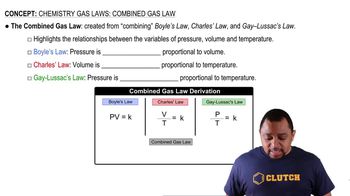
Combined Gas Law
Partial Pressure
Partial pressure is the pressure exerted by a single gas in a mixture of gases. According to Dalton's Law, the total pressure of a gas mixture is the sum of the partial pressures of each individual gas. This concept is essential for understanding how the pressures of helium and argon will change when the gases mix.
Recommended video:
Guided course
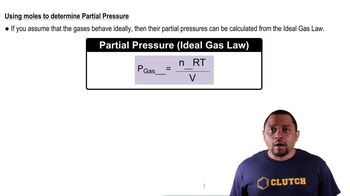
Partial Pressure Calculation
Volume and Molar Relationships
The volume occupied by a gas is directly related to the number of moles present and the conditions of temperature and pressure. When gases mix, they will occupy the total volume available, and the distribution of gas molecules will depend on their initial conditions. This relationship is key to predicting how the volume of nitrogen gas will change in the given scenario.
Related Practice
Textbook Question
1135
views
Textbook Question
Consider a mixture of two gases, A and B, confined in a closed vessel. A quantity of a third gas, C, is added to the same vessel at the same temperature. How does the addition of gas C affect the following: (a) the partial pressure of gas A?
835
views
Textbook Question
Acetylene gas, C2H2(𝑔), can be prepared by the reaction of calcium carbide with water:
CaC2(𝑠)+2 H2O(𝑙)⟶Ca(OH)2(𝑎𝑞)+C2H2(𝑔)
Calculate the volume of C2H2 that is collected over water at 23°C by reaction of 1.524 g of CaC2 if the total pressure of the gas is 753 torr. (The vapor pressure of water is tabulated in Appendix B.)