
Ethylene glycol (HOCH2CH2OH), the major substance in antifreeze, has a normal boiling point of 198 °C. By comparison, ethyl alcohol (CH3CH2OH) boils at 78 °C at atmospheric pressure. Ethylene glycol dimethyl ether (CH3OCH2CH2OCH3) has a normal boiling point of 83 °C, and ethyl methyl ether (CH3CH2OCH3) has a nomral boiling point of 11 °C. (b) What are the major factors responsible for the difference in boiling points of the two ethers?
Ch.11 - Liquids and Intermolecular Forces

Brown15th EditionChemistry: The Central ScienceISBN: 9780137542970Not the one you use?Change textbook
Chapter 11, Problem 29a
Ethylene glycol (HOCH2CH2OH), the major substance in antifreeze, has a normal boiling point of 198 °C. By comparison, ethyl alcohol (CH3CH2OH) boils at 78 °C at atmospheric pressure. Ethylene glycol dimethyl ether (CH3OCH2CH2OCH3) has a normal boiling point of 83 °C, and ethyl methyl ether (CH3CH2OCH3) has a nomral boiling point of 11 °C. (a) Explain why replacement of a hydrogen on the oxygen by a CH3 group generally results in a lower boiling point.
Verified step by step guidance1
Identify the functional groups in each compound and understand their influence on intermolecular forces. Ethylene glycol has hydroxyl groups (OH), ethyl alcohol also has a hydroxyl group, while the ethers (ethylene glycol dimethyl ether and ethyl methyl ether) contain ether groups (C-O-C).
Recognize that hydroxyl groups can form hydrogen bonds, which are strong intermolecular forces that significantly increase the boiling points of compounds.
Understand that when a hydrogen in a hydroxyl group is replaced by a methyl group (CH3), the ability to form hydrogen bonds is lost, leading to weaker intermolecular forces in ethers compared to alcohols.
Compare the boiling points of the compounds to see the effect of the functional groups. Note that compounds with hydroxyl groups (capable of hydrogen bonding) have higher boiling points than those with ether groups, which mainly exhibit dipole-dipole interactions and London dispersion forces.
Conclude that the replacement of a hydrogen atom on the oxygen by a methyl group in ethers reduces the boiling point because it prevents the formation of hydrogen bonds, leading to weaker intermolecular forces compared to alcohols.

Verified video answer for a similar problem:
This video solution was recommended by our tutors as helpful for the problem above.
Video duration:
1mWas this helpful?
Key Concepts
Here are the essential concepts you must grasp in order to answer the question correctly.
Hydrogen Bonding
Hydrogen bonding is a strong type of dipole-dipole attraction that occurs when hydrogen is bonded to highly electronegative atoms like oxygen or nitrogen. In molecules like ethylene glycol and ethyl alcohol, hydrogen bonds significantly increase boiling points due to the energy required to break these interactions. When a hydrogen atom is replaced by a methyl group (CH3), the ability to form hydrogen bonds is reduced, leading to lower boiling points.
Molecular Structure and Polarity
The molecular structure and polarity of a compound influence its boiling point. Polar molecules, which have an uneven distribution of charge, tend to have higher boiling points due to stronger intermolecular forces. In the case of ethers like ethyl methyl ether, the presence of nonpolar methyl groups decreases overall polarity, resulting in weaker intermolecular forces and lower boiling points compared to more polar alcohols.
Recommended video:
Guided course
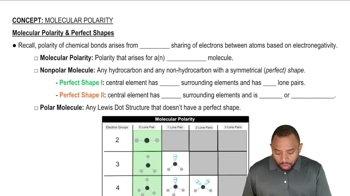
Molecular Polarity
Intermolecular Forces
Intermolecular forces are the forces of attraction between molecules, which include hydrogen bonds, dipole-dipole interactions, and London dispersion forces. The strength and type of these forces directly affect a substance's boiling point. When a hydrogen atom is replaced by a methyl group, the overall intermolecular forces are weakened, leading to a decrease in boiling point as less energy is needed to separate the molecules during the phase change from liquid to gas.
Recommended video:
Guided course
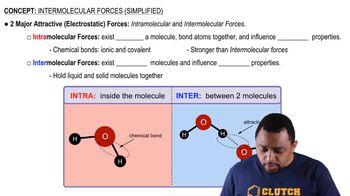
Intermolecular vs Intramolecular Forces
Related Practice
Textbook Question
Textbook Question
Which member in each pair has the greater dispersion forces? (b) CO2 or CO, (c) SiH4 or GeH4.
755
views
Textbook Question
Which member in each pair has the stronger intermolecular dispersion forces? (a) Br2 or O2 (b) CH3CH2CH2CH2SH or CH3CH2CH2CH2CH2SH (c) CH3CH2CH2Cl or (CH3)2CHCl
1319
views
Textbook Question
Based on the type or types of intermolecular forces, predict the substance in each pair that has the higher boiling point: (a) propane (C3H8) or n-butane (C4H10) (b) diethyl ether (CH3CH2OCH2CH3) or 1-butanol (CH3CH2CH2CH2OH) (c) sulfur dioxide (SO2) or sulfur trioxide (SO3) (d) phosgene (Cl2CO) or formaldehyde (H2CO)
1364
views
