Ch.11 - Liquids and Intermolecular Forces
Brown - Chemistry: The Central Science 15th Edition
Brown15th EditionChemistry: The Central ScienceISBN: 9780137542970Not the one you use?Change textbook
Chapter 11, Problem 94

The vapor pressure of ethanol (C2H5OH) at 19 °C is 40.0 torr. A 1.00-g sample of ethanol is placed in a 2.00 L container at 19 °C. If the container is closed and the ethanol is allowed to reach equilibrium with its vapor, how many grams of liquid ethanol remain?

Verified step by step guidance
1
First, we need to convert the vapor pressure of ethanol from torr to atmospheres because the ideal gas law uses pressure in atmospheres. We can do this using the conversion factor 1 atm = 760 torr.
Next, we use the ideal gas law (PV=nRT) to calculate the number of moles of ethanol in the vapor phase. In this case, P is the pressure in atmospheres, V is the volume in liters, n is the number of moles, R is the ideal gas constant (0.0821 L·atm/K·mol), and T is the temperature in Kelvin.
Once we have the number of moles of ethanol in the vapor phase, we can convert this to grams using the molar mass of ethanol (46.07 g/mol). This will give us the mass of ethanol that has evaporated.
We then subtract the mass of evaporated ethanol from the initial mass of ethanol to find the mass of liquid ethanol that remains.
Remember that the ideal gas law assumes ideal behavior, so this calculation will be an approximation. Real gases do not always behave ideally, especially at high pressures and low temperatures.

Verified video answer for a similar problem:

This video solution was recommended by our tutors as helpful for the problem above.
Video duration:
5m
Was this helpful?

Key Concepts

Here are the essential concepts you must grasp in order to answer the question correctly.

Vapor Pressure

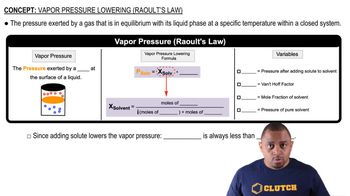
Vapor pressure is the pressure exerted by a vapor in equilibrium with its liquid or solid phase at a given temperature. It indicates the tendency of a substance to evaporate; higher vapor pressure means a greater tendency to vaporize. For ethanol at 19 °C, the vapor pressure is 40.0 torr, which is crucial for determining how much liquid will remain when equilibrium is reached.
Recommended video:
Guided course
02:40
Raoult's Law and Vapor Pressure

Equilibrium

In chemistry, equilibrium refers to the state where the rates of the forward and reverse reactions are equal, resulting in constant concentrations of reactants and products. In this scenario, the equilibrium between liquid ethanol and its vapor will dictate how much ethanol remains in the liquid state once the system stabilizes in the closed container.

Ideal Gas Law

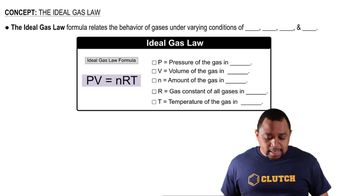
The Ideal Gas Law (PV = nRT) relates the pressure, volume, temperature, and number of moles of a gas. In this problem, it can be used to calculate the number of moles of ethanol vapor present at equilibrium, which helps determine how much liquid ethanol remains after some has evaporated into the vapor phase.
Recommended video:
Guided course
01:15
Ideal Gas Law Formula
Related Practice
Textbook Question

Naphthalene (C10H8) is the main ingredient in traditional mothballs. Its normal melting point is 81 °C, its normal boiling point is 218 °C, and its triple point is 80 °C at 1000 Pa. Using the data, construct a phase diagram for naphthalene, labeling all the regions of your diagram.

2401
views
Textbook Question

Using information in Appendices B and C, calculate the minimum grams of propane, C3H8(g), that must be combusted to provide the energy necessary to convert 5.50 kg of ice at -20 °C to liquid water at 75 °C

789
views
Textbook Question

Suppose the vapor pressure of a substance is measured at two different temperatures.

a. By using the Clausius–Clapeyron equation (Equation 11.1), derive the following relationship between the vapor pressures, 𝑃1 and 𝑃2, and the absolute temperatures at which they were measured, 𝑇1 and 𝑇2:

ln𝑃1𝑃2=−Δ𝐻vap𝑅(1𝑇1−1𝑇2)

b. Gasoline is a mixture of hydrocarbons, a component of which is octane (CH3CH2CH2CH2CH2CH2CH2CH3). Octane has a vapor pressure of 13.95 torr at 25°C and a vapor pressure of 144.78 torr at 75°C. Use these data and the equation in part (a) to calculate the heat of vaporization of octane.

c. By using the equation in part (a) and the data given in part (b), calculate the normal boiling point of octane. Compare your answer to the one you obtained from Exercise 11.83.

d. Calculate the vapor pressure of octane at −30°C.


1
views
Textbook Question

In Table 11.3, we saw that the viscosity of a series of hydrocarbons increased with molecular weight, doubling from the six-carbon molecule to the ten-carbon molecule.

(a) The eight-carbon hydrocarbon, octane, has an isomer, isooctane. Would you predict that isooctane would have a larger or smaller viscosity than octane? Why?

530
views