
Suppose that you want to use reverse osmosis to reduce the salt content of brackish water containing 0.22 M total salt concentration to a value of 0.01 M, thus rendering it usable for human consumption. What is the minimum pressure that needs to be applied in the permeators (Figure 13.26) to achieve this goal, assuming that the operation occurs at 298 K?
Ch.13 - Properties of Solutions

Brown15th EditionChemistry: The Central ScienceISBN: 9780137542970Not the one you use?Change textbook
Chapter 13, Problem 55
Commercial aqueous nitric acid has a density of 1.42 g/mL and is 16 M. Calculate the percent HNO3 by mass in the solution.
Verified step by step guidance1
Determine the molar mass of HNO_3 by adding the atomic masses of hydrogen (H), nitrogen (N), and oxygen (O).
Use the molarity (16 M) to find the number of moles of HNO_3 in 1 liter of solution.
Convert the moles of HNO_3 to grams using the molar mass calculated in step 1.
Calculate the mass of 1 liter of the solution using its density (1.42 g/mL).
Find the percent by mass of HNO_3 by dividing the mass of HNO_3 by the total mass of the solution and multiplying by 100.

Verified video answer for a similar problem:
This video solution was recommended by our tutors as helpful for the problem above.
Video duration:
2mWas this helpful?
Key Concepts
Here are the essential concepts you must grasp in order to answer the question correctly.
Molarity (M)
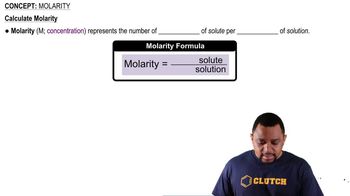
Molarity is a measure of concentration defined as the number of moles of solute per liter of solution. In this case, a 16 M nitric acid solution means there are 16 moles of HNO3 in every liter of the solution. Understanding molarity is crucial for converting between moles and mass, which is necessary for calculating percent by mass.
Recommended video:
Guided course
Molarity Concept
Density
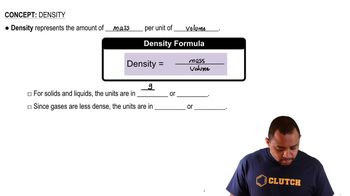
Density is the mass of a substance per unit volume, typically expressed in grams per milliliter (g/mL). The density of the nitric acid solution is given as 1.42 g/mL, which allows us to determine the mass of the solution when we know its volume. This relationship is essential for calculating the total mass of the solution needed to find the percent by mass of HNO3.
Recommended video:
Guided course
Density Concepts
Percent by Mass
Percent by mass is a way to express the concentration of a component in a mixture, calculated as the mass of the solute divided by the total mass of the solution, multiplied by 100. To find the percent by mass of HNO3 in the solution, we need to determine the mass of HNO3 present and the total mass of the solution, which involves using both molarity and density.
Related Practice
Textbook Question
Textbook Question
Describe how you would prepare each of the following aqueous solutions from water and solid KBr: b. 125 g of 0.180 m KBr.
1
views
Textbook Question
Brass is a substitutional alloy consisting of a solution of copper and zinc. A particular sample of red brass consisting of 80.0 % Cu and 20.0 % Zn by mass has a density of 8750 kg/m3. (a) What is the molality of Zn in the solid solution?
1945
views
Textbook Question
Describe how you would prepare each of the following aqueous solutions from water and the solid solute: a. 1.50 L of 0.110 M (NH4)2SO4 solution;
Textbook Question
Brass is a substitutional alloy consisting of a solution of copper and zinc. A particular sample of red brass consisting of 80.0 % Cu and 20.0 % Zn by mass has a density of 8750 kg/m3. (b) What is the molarity of Zn in the solution?
966
views
