
Lauryl alcohol is obtained from coconut oil and is used to make detergents. A solution of 5.00 g of lauryl alcohol in 0.100 kg of benzene freezes at 4.1 °C. What is the molar mass of lauryl alcohol from these data? See Table 13.3 for the normal freezing point and 𝐾f of benzene.
Ch.13 - Properties of Solutions

Brown15th EditionChemistry: The Central ScienceISBN: 9780137542970Not the one you use?Change textbook
Chapter 13, Problem 79
What is the osmotic pressure formed by dissolving 44.2 mg of aspirin (C9H8O4) in 0.358 L of water at 25 °C?
Verified step by step guidance1
Step 1: Convert the mass of aspirin from milligrams to grams by dividing by 1000. This will make it easier to work with in subsequent calculations.
Step 2: Calculate the number of moles of aspirin using its molar mass. The molar mass of aspirin (C9H8O4) can be found by adding the atomic masses of all the atoms in the formula.
Step 3: Determine the molarity of the aspirin solution by dividing the number of moles of aspirin by the volume of the solution in liters.
Step 4: Use the formula for osmotic pressure, \( \Pi = iMRT \), where \( i \) is the van't Hoff factor (which is 1 for non-electrolytes like aspirin), \( M \) is the molarity, \( R \) is the ideal gas constant (0.0821 L·atm/mol·K), and \( T \) is the temperature in Kelvin. Convert the temperature from Celsius to Kelvin by adding 273.15.
Step 5: Substitute the values for \( i \), \( M \), \( R \), and \( T \) into the osmotic pressure formula to find the osmotic pressure.
Key Concepts
Here are the essential concepts you must grasp in order to answer the question correctly.
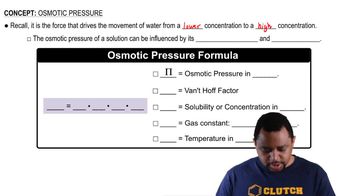
Osmotic Pressure
Osmotic pressure is the pressure required to prevent the flow of solvent into a solution through a semipermeable membrane. It is directly proportional to the concentration of solute particles in the solution and can be calculated using the formula π = iCRT, where π is the osmotic pressure, i is the van 't Hoff factor, C is the molarity of the solution, R is the ideal gas constant, and T is the temperature in Kelvin.
Recommended video:
Guided course
Osmotic Pressure Formula
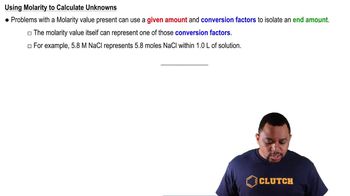
Molarity
Molarity is a measure of concentration defined as the number of moles of solute per liter of solution. It is expressed in moles per liter (mol/L). To calculate molarity, one must first convert the mass of the solute (in this case, aspirin) into moles using its molar mass, and then divide by the volume of the solution in liters.
Recommended video:
Guided course
Molarity
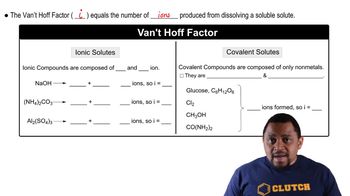
Van 't Hoff Factor
The van 't Hoff factor (i) indicates the number of particles into which a solute dissociates in solution. For non-electrolytes like aspirin, which does not dissociate into ions, the van 't Hoff factor is 1. This factor is crucial for accurately calculating colligative properties, including osmotic pressure, as it affects the total concentration of solute particles in the solution.
Recommended video:
Guided course
Van't Hoff Factor
Related Practice
Textbook Question
Textbook Question
List the following aqueous solutions in order of increasing boiling point: 0.120 m glucose, 0.050 m LiBr, 0.050 m Zn(NO3)2.
1410
views
Textbook Question
Lysozyme is an enzyme that breaks bacterial cell walls. A solution containing 0.150 g of this enzyme in 210 mL of solution has an osmotic pressure of 0.953 torr at 25 °C. What is the molar mass of lysozyme?
2030
views
Textbook Question
Adrenaline is the hormone that triggers the release of extra glucose molecules in times of stress or emergency. A solution of 0.64 g of adrenaline in 36.0 g of CCl4 elevates the boiling point by 0.49 °C. Calculate the approximate molar mass of adrenaline from this data.
845
views
