
Textbook Question
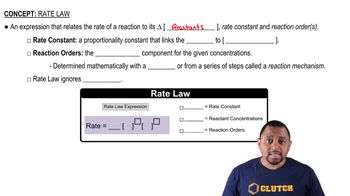
(a) The gas-phase decomposition of SO2Cl2, SO2Cl2(g) → SO2(g) + Cl2(g), is first order in SO2Cl2. At 600 K the half-life for this process is 2.3 × 10⁵ s. What is the rate constant at this temperature?
1430
views

 Verified step by step guidance
 01:52
01:52
 00:36
00:36 01:14
01:14(a) The gas-phase decomposition of SO2Cl2, SO2Cl2(g) → SO2(g) + Cl2(g), is first order in SO2Cl2. At 600 K the half-life for this process is 2.3 × 10⁵ s. What is the rate constant at this temperature?
The following data were measured for the reaction BF3(g) + NH3(g) → F3BNH3(g):
Experiment [BF3] (M) [NH3] (M) Initial Rate (M/s)
1 0.250 0.250 0.2130
2 0.250 0.125 0.1065
3 0.200 0.100 0.0682
4 0.350 0.100 0.1193
5 0.175 0.100 0.0596
(c) Calculate the rate constant with proper units?
(b) At 320°C the rate constant is 2.2 × 10⁻⁵ s-1. What is the half-life at this temperature?
The following data were measured for the reaction BF3(g) + NH3(g) → F3BNH3(g):
Experiment [BF3] (M) [NH3] (M) Initial Rate (M/s)
1 0.250 0.250 0.2130
2 0.250 0.125 0.1065
3 0.200 0.100 0.0682
4 0.350 0.100 0.1193
5 0.175 0.100 0.0596
(b) What is the overall order of the reaction?
(a) For the generic reaction A → B what quantity, when graphed versus time, will yield a straight line for a first-order reaction?