
Textbook Question
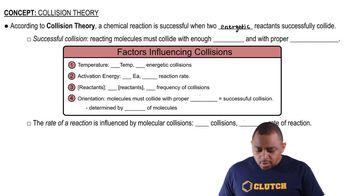
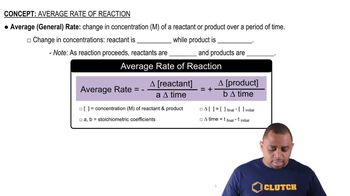
Indicate whether each statement is true or false. (b) Exothermic reactions are faster than endothermic reactions.
868
views

 Verified step by step guidance
 02:08
02:08
 02:03
02:03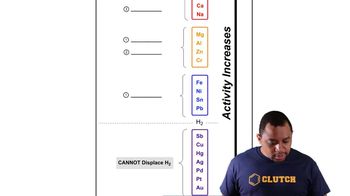 02:02
02:02Indicate whether each statement is true or false. (b) Exothermic reactions are faster than endothermic reactions.
Based on their activation energies and energy changes and assuming that all collision factors are the same, rank the following reactions from slowest to fastest. (a) Ea = 45 kJ>mol; E = -25 kJ>mol (b) Ea = 35 kJ>mol; E = -10 kJ>mol (c) Ea = 55 kJ>mol; E = 10 kJ>mol
The gas-phase reaction Cl(g) + HBr(g) → HCl(g) + Br(g) has an overall energy change of -66 kJ. The activation energy for the reaction is 7 kJ. (b) What is the activation energy for the reverse reaction?
Indicate whether each statement is true or false. (a) If you measure the rate constant for a reaction at different temperatures, you can calculate the overall enthalpy change for the reaction.
The gas-phase reaction Cl(g) + HBr(g) → HCl(g) + Br(g) has an overall energy change of -66 kJ. The activation energy for the reaction is 7 kJ. (a) Sketch the energy profile for the reaction, and label Ea and ΔE.