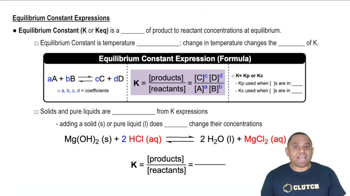
Nitric oxide (NO) reacts readily with chlorine gas as follows: 2 NO(π) + Cl2(π) β 2 NOCl(π) At 700 K, the equilibrium constant πΎπ for this reaction is 0.26. For each of the following mixtures at this temperature, indicate whether the mixture is at equilibrium, or, if not, whether it needs to produce more products or reactants to reach equilibrium. (b) πNO = 0.12atm, πCl2 = 0.10atm, πNOCl = 0.050atm

At 700 K, the equilibrium constant for the reaction CCl4(π) β C(π ) + 2 Cl2(π) is πΎπ = 0.76. A flask is charged with 2.00 atm of CCl4, which then reaches equilibrium at 700 K. (a) What fraction of the CCl4 is converted into C and Cl2?
Verified step by step guidance
Verified video answer for a similar problem:
Key Concepts
Equilibrium Constant (Kp)
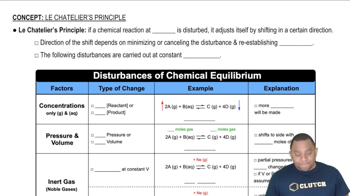
Le Chatelier's Principle
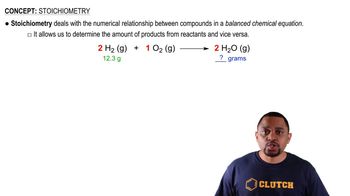
Stoichiometry of the Reaction
The equilibrium constant constant πΎπ for C(π ) + CO2(π) β 2 CO(π) is 1.9 at 1000 K and 0.133 at 298 K. (a) If excess C is allowed to react with 25.0 g of CO2 in a 3.00-L vessel at 1000 K, how many grams of CO are produced? (b) If excess C is allowed to react with 25.0 g of CO2 in a 3.00-L vessel at 1000 K, how many grams of C are consumed?
Consider the hypothetical reaction A(π) + 2 B(π) β 2 C(π), for which πΎπ = 0.25 at a certain temperature. A 1.00-L reaction vessel is loaded with 1.00 mol of compound C, which is allowed to reach equilibrium. Let the variable x represent the number of mol/L of compound A present at equilibrium.
(d) The equation from part (c) is a cubic equation (one that has the form ax3 + bx2 + cx + d = 0). In general, cubic equations cannot be solved in closed form. However, you can estimate the solution by plotting the cubic equation in the allowed range of x that you specified in part (b). The point at which the cubic equation crosses the x-axis is the solution.
(e) From the plot in part (d), estimate the equilibrium concentrations of A, B, and C. (Hint: You can check the accuracy of your answer by substituting these concentrations into the equilibrium expression.)

At 700 K, the equilibrium constant for the reaction CCl4(π) β C(π ) + 2 Cl2(π) is πΎπ = 0.76. A flask is charged with 2.00 atm of CCl4, which then reaches equilibrium at 700 K. (b) What are the partial pressures of CCl4 and Cl2 at equilibrium?