Methanol (CH3OH) can be made by the reaction of CO with H2: CO(π) + 2 H2(π) β CH3OH(π) (b) To maximize the equilibrium yield of methanol, would you use a high or low temperature?
Ch.15 - Chemical Equilibrium

Brown15th EditionChemistry: The Central ScienceISBN: 9780137542970Not the one you use?Change textbook
Chapter 15, Problem 69b
(b) If the temperature is raised by 100 K, does the equilibrium constant for this reaction increase or decrease?
Verified step by step guidance1
insert step 1> Identify the type of reaction (endothermic or exothermic) using the enthalpy change (\( \Delta H \)) of the reaction.
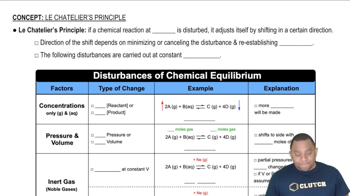
insert step 2> Recall Le Chatelier's Principle, which states that a system at equilibrium will adjust to counteract any changes imposed on it.
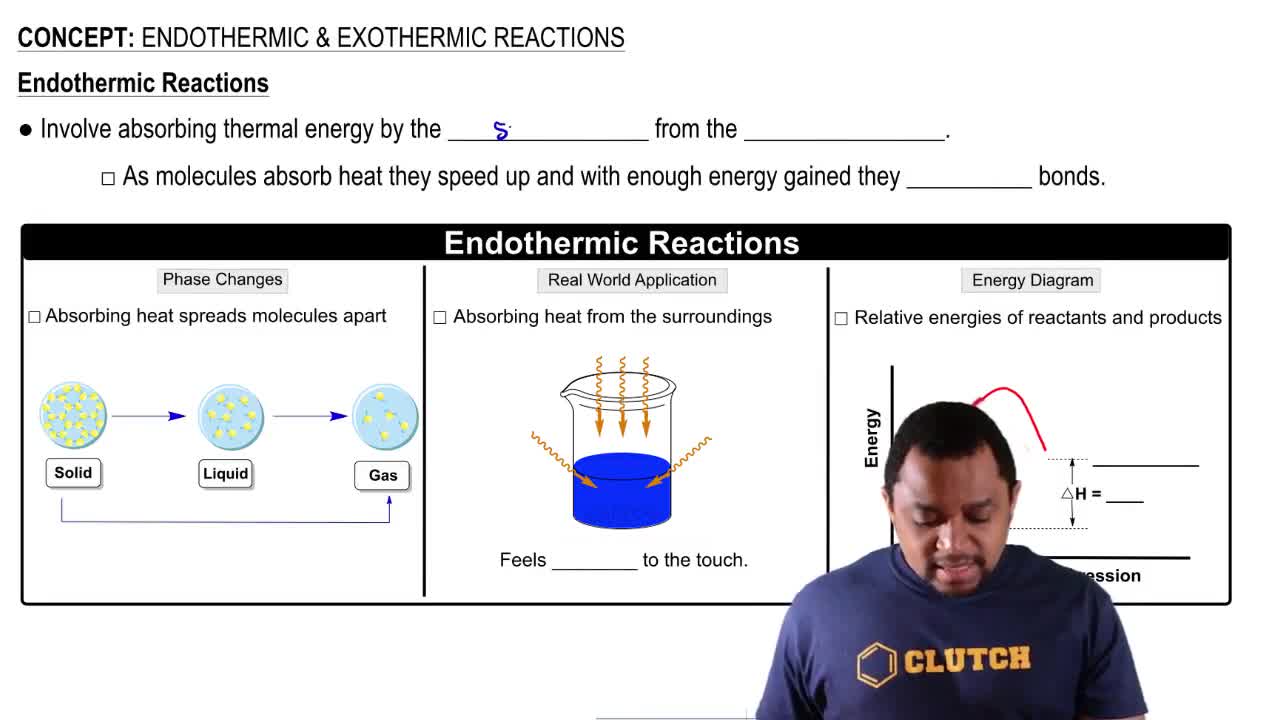
insert step 3> Understand that for an endothermic reaction (\( \Delta H > 0 \)), increasing temperature shifts the equilibrium to the right, favoring the formation of products, thus increasing the equilibrium constant (\( K \)).
insert step 4> Conversely, for an exothermic reaction (\( \Delta H < 0 \)), increasing temperature shifts the equilibrium to the left, favoring the formation of reactants, thus decreasing the equilibrium constant (\( K \)).
insert step 5> Conclude whether the equilibrium constant increases or decreases based on the reaction's enthalpy change and the temperature increase.

Verified video answer for a similar problem:
This video solution was recommended by our tutors as helpful for the problem above.
Video duration:
3mWas this helpful?
Key Concepts
Here are the essential concepts you must grasp in order to answer the question correctly.
Le Chatelier's Principle
Le Chatelier's Principle states that if a dynamic equilibrium is disturbed by changing the conditions, the system will adjust to counteract the change and restore a new equilibrium. This principle helps predict how changes in temperature, pressure, or concentration will affect the position of equilibrium in a chemical reaction.
Recommended video:
Guided course
Le Chatelier's Principle
Temperature and Equilibrium Constant
The equilibrium constant (K) of a reaction is temperature-dependent. For exothermic reactions, increasing the temperature typically decreases K, while for endothermic reactions, increasing the temperature usually increases K. Understanding the nature of the reaction (exothermic or endothermic) is crucial to predicting how K will change with temperature.
Exothermic and Endothermic Reactions
Exothermic reactions release heat, resulting in a negative change in enthalpy (ΞH < 0), while endothermic reactions absorb heat, leading to a positive change in enthalpy (ΞH > 0). The classification of a reaction as exothermic or endothermic is essential for determining how the equilibrium constant will respond to temperature changes.
Recommended video:
Guided course
Endothermic & Exothermic Reactions
Related Practice
Textbook Question
583
views
Textbook Question
(a) Is the dissociation of fluorine molecules into atomic fluorine, F2(π) β 2 F(π), an exothermic or endothermic process?
711
views
Textbook Question
(c) If the temperature is raised by 100 K, does the forward rate constant kf increase by a larger or smaller amount than the reverse rate constant kr?
Textbook Question
When 2.00 mol of SO2Cl2 is placed in a 2.00-L flask at 303 K, 56% of the SO2Cl2 decomposes to SO2 and Cl2: SO2Cl2(g) β SO2(g) + Cl2(g) (a) Calculate Kc for this reaction at this temperature.
1261
views
1
rank
Textbook Question
Ozone, O3, decomposes to molecular oxygen in the stratosphere according to the reaction 2 O3(π) βΆ 3 O2(π). Would increasing the pressure by decreasing the size of the reaction vessel favor the formation of ozone or of oxygen?