Methanol (CH3OH) can be made by the reaction of CO with H2: CO(𝑔) + 2 H2(𝑔) ⇌ CH3OH(𝑔) (b) To maximize the equilibrium yield of methanol, would you use a high or low temperature?
Ch.15 - Chemical Equilibrium

Brown15th EditionChemistry: The Central ScienceISBN: 9780137542970Not the one you use?Change textbook
Chapter 15, Problem 65a
Consider the following equilibrium between oxides of nitrogen 3 NO(g) ⇌ NO2(g) + N2O(g) (a) At constant temperature, would a change in the volume of the container affect the fraction of products in the equilibrium mixture?
Verified step by step guidance1
Understand the concept of Le Chatelier's Principle, which states that if a dynamic equilibrium is disturbed by changing the conditions, the position of equilibrium shifts to counteract the change.
Identify the change in conditions: In this case, the volume of the container is changed.
Recognize that changing the volume of a gaseous equilibrium system affects the pressure. A decrease in volume increases pressure, while an increase in volume decreases pressure.
Count the moles of gas on each side of the equilibrium: On the left side, there are 3 moles of NO(g), and on the right side, there are 1 mole of NO2(g) and 1 mole of N2O(g), totaling 2 moles.
Apply Le Chatelier's Principle: If the volume decreases (pressure increases), the equilibrium will shift towards the side with fewer moles of gas to reduce pressure, which is the right side (products). Conversely, if the volume increases (pressure decreases), the equilibrium will shift towards the left side (reactants).

Verified video answer for a similar problem:
This video solution was recommended by our tutors as helpful for the problem above.
Video duration:
2mWas this helpful?
Key Concepts
Here are the essential concepts you must grasp in order to answer the question correctly.
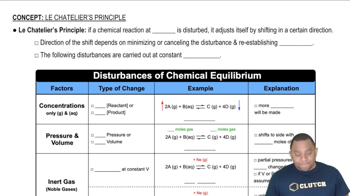
Le Chatelier's Principle
Le Chatelier's Principle states that if a dynamic equilibrium is disturbed by changing the conditions, the system will adjust to counteract the change and restore a new equilibrium. In the context of gas reactions, changes in volume can affect the concentrations of reactants and products, prompting the system to shift in a direction that minimizes the effect of the change.
Recommended video:
Guided course
Le Chatelier's Principle
Equilibrium Constant (K)
The equilibrium constant (K) is a numerical value that expresses the ratio of the concentrations of products to reactants at equilibrium for a given reaction at a specific temperature. For the reaction 3 NO(g) ⇌ NO<sub>2</sub>(g) + N<sub>2</sub>O(g), the equilibrium constant can help predict how changes in volume or pressure will affect the concentrations of the gases involved.
Recommended video:
Guided course
Equilibrium Constant K
Gas Laws and Volume Changes
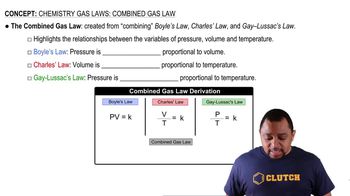
Gas laws describe the behavior of gases under various conditions of pressure, volume, and temperature. According to Boyle's Law, decreasing the volume of a gas increases its pressure, which can shift the equilibrium position of a reaction involving gases. Understanding how volume changes impact gas behavior is crucial for predicting the outcome of equilibrium reactions.
Recommended video:
Guided course
Combined Gas Law
Related Practice
Textbook Question
583
views
Textbook Question
Methanol (CH3OH) can be made by the reaction of CO with H2: CO(𝑔) + 2 H2(𝑔) ⇌ CH3OH(𝑔) (a) Use thermochemical data in Appendix C to calculate ΔH° for this reaction.
1098
views
Textbook Question
Consider the reaction 4 NH3(𝑔) + 5 O2(𝑔) ⇌ 4 NO(𝑔) + 6 H2O(𝑔), Δ𝐻 = −904.4 kJ Does each of the following increase, decrease, or leave unchanged the yield of NO at equilibrium? (f) increase temperature.
409
views
Textbook Question
Ozone, O3, decomposes to molecular oxygen in the stratosphere according to the reaction 2 O3(𝑔) ⟶ 3 O2(𝑔). Would increasing the pressure by decreasing the size of the reaction vessel favor the formation of ozone or of oxygen?