
For the equilibrium Br2(𝑔) + Cl2(𝑔) ⇌ 2 BrCl(𝑔) at 400 K, 𝐾𝑐 = 7.0. If 0.25 mol of Br2 and 0.55 mol of Cl2 are introduced into a 3.0-L container at 400 K, what will be the equilibrium concentrations of Br2, Cl2, and BrCl?

For the reaction I2(g) + Br2(g) ⇌ 2 IBr(g), Kc = 280 at 150 _x001F_C. Suppose that 0.500 mol IBr in a 2.00-L flask is allowed to reach equilibrium at 150 _x001F_C. What are the equilibrium concentrations of IBr, I2, and Br2?
Verified step by step guidanceKey Concepts
Equilibrium Constant (Kc)
Initial Concentration and Changes at Equilibrium
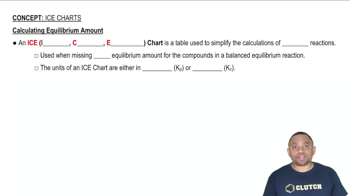
ICE Table (Initial, Change, Equilibrium)
At 80°C, 𝐾𝑐 = 1.87×10⁻³ for the reaction PH3BCl3(𝑠) ⇌ PH3(𝑔) + BCl3(𝑔) (a) Calculate the equilibrium concentrations of PH3 and BCl3 if a solid sample of PH3BCl3 is placed in a closed vessel at 80°C and decomposes until equilibrium is reached.
At 373 K, 𝐾𝑝 = 0.416 for the equilibrium 2 NOBr(𝑔) ⇌ 2 NO(𝑔) + Br2(𝑔) If the equilibrium partial pressures of NOBr(𝑔) and Br2(𝑔) are both 0.100 atm at 373 K, what is the equilibrium partial pressure of NO(𝑔)?
At 80°C, 𝐾𝑐 = 1.87×10⁻³ for the reaction PH3BCl3(𝑠) ⇌ PH3(𝑔) + BCl3(𝑔) (a) Calculate the equilibrium concentrations of PH3 and BCl3 if a solid sample of PH3BCl3 is placed in a closed vessel at 80°C and decomposes until equilibrium is reached. (b) If the flask has a volume of 0.250 L, what is the minimum mass of PH3BCl3(𝑠) that must be added to the flask to achieve equilibrium?
