
Textbook Question
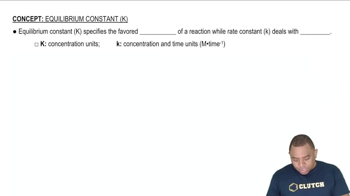
Write the expressions for 𝐾𝑐 for the following reactions. In each case indicate whether the reaction is homogeneous or heterogeneous.
(b) Ti(𝑠) + 2Cl2(𝑔) ⇌ TiCl4(𝑙)
460
views

 Verified step by step guidance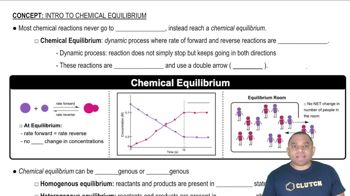
 04:21
04:21
 01:14
01:14 07:32
07:32Write the expressions for 𝐾𝑐 for the following reactions. In each case indicate whether the reaction is homogeneous or heterogeneous.
(b) Ti(𝑠) + 2Cl2(𝑔) ⇌ TiCl4(𝑙)
Write the expressions for Kc for the following reactions. In each case indicate whether the reaction is homogeneous or heterogeneous.
(a) 2 O3(g) ⇌ 3 O2(g)
(c) 2 C2H4(g) + 2 H2O(g) ⇌ 2 C2H6(g) + O2(g)
(d) C(s) + 2 H2(g) ⇌ CH4(g)
(e) 4 HCl(aq) + O2(g) ⇌ 2 H2O(l) + 2 Cl2(g)
(f) 2 C8H18(l) + 25 O2(g) ⇌ 16 CO2(g) + 18 H2O(g)
(g) 2 C8H18(l) + 25 O2(g) ⇌ 16 CO2(g) + 18 H2O(l)
Consider the following equilibrium: 2 H2(g) + S2(g) ⇌ 2 H2S(g) Kc = 1.08 × 10⁷ at 700°C (b) Does the equilibrium mixture contain mostly H2 and S2 or mostly H2S?
Write the expression for Kc for the following reactions. In each case indicate whether the reaction is homogeneous or heterogeneous.
(a) 3 NO(g) ⇌ N2O(g) + NO2(g)
(b) CH4(g) + 2 H2S(g) ⇌ CS2(g) + 4 H2(g)
(c) Ni(CO)4(g) ⇌ Ni(s) + 4 CO(g)
(d) HF(aq) ⇌ H+(aq) + F-(aq)
(e) 2Ag(s) + Zn2+(aq) ⇌ 2 Ag+(aq) + Zn(s)
(f) H2O(l) ⇌ H+(aq) + OH-(aq)
(g) 2 H2O(l) ⇌ 2 H+(aq) + 2 OH-(aq)