Butyric acid is responsible for the foul smell of rancid butter. The pKa of butyric acid is 4.84. (a) Calculate the pKb for the butyrate ion.
Ch.16 - Acid-Base Equilibria

Brown15th EditionChemistry: The Central ScienceISBN: 9780137542970Not the one you use?Change textbook
Chapter 16, Problem 108c
Butyric acid is responsible for the foul smell of rancid butter. The pKa of butyric acid is 4.84. (c) Calculate the pH of a 0.050 M solution of sodium butyrate.
Verified step by step guidance1
Identify that sodium butyrate is the salt of butyric acid and will hydrolyze in water to form butyric acid and hydroxide ions.
Write the hydrolysis equation: \( \text{C}_4\text{H}_7\text{COONa} + \text{H}_2\text{O} \rightleftharpoons \text{C}_4\text{H}_7\text{COOH} + \text{OH}^- \).
Use the relationship between \( K_a \) and \( K_b \) for a conjugate acid-base pair: \( K_w = K_a \times K_b \), where \( K_w = 1.0 \times 10^{-14} \) at 25°C.
Calculate \( K_b \) using the given \( pK_a \) of butyric acid: \( K_a = 10^{-pK_a} \), then \( K_b = \frac{K_w}{K_a} \).
Set up the expression for \( K_b \) and solve for \( [OH^-] \) using the initial concentration of sodium butyrate and the assumption that \( x \) (the change in concentration) is small compared to the initial concentration.

Verified video answer for a similar problem:
This video solution was recommended by our tutors as helpful for the problem above.
Video duration:
5mWas this helpful?
Key Concepts
Here are the essential concepts you must grasp in order to answer the question correctly.
pKa and pH Relationship
The pKa value of an acid indicates the strength of the acid in solution, with lower pKa values corresponding to stronger acids. The pH of a solution is a measure of its hydrogen ion concentration. In the case of weak acids and their conjugate bases, the Henderson-Hasselbalch equation can be used to relate pH, pKa, and the concentrations of the acid and its conjugate base.
Recommended video:
Guided course
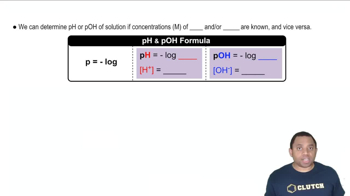
pH and pOH Calculations
Sodium Butyrate as a Conjugate Base
Sodium butyrate is the sodium salt of butyric acid, and it acts as a conjugate base in solution. When dissolved in water, it dissociates to release butyrate ions, which can accept protons, thereby affecting the pH of the solution. Understanding the role of sodium butyrate as a weak base is essential for calculating the resulting pH.
Recommended video:
Guided course
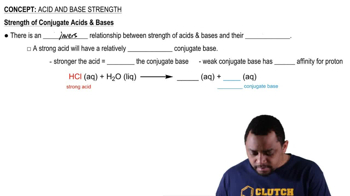
Strength of Conjugate Acids and Bases
Henderson-Hasselbalch Equation
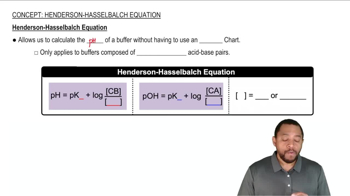
The Henderson-Hasselbalch equation is a formula used to calculate the pH of a buffer solution. It is expressed as pH = pKa + log([A-]/[HA]), where [A-] is the concentration of the conjugate base and [HA] is the concentration of the weak acid. In this scenario, since sodium butyrate is the conjugate base and butyric acid is the weak acid, this equation will help determine the pH of the sodium butyrate solution.
Recommended video:
Guided course
Henderson-Hasselbalch Equation
Related Practice
Textbook Question
1153
views
Textbook Question
The following observations are made about a diprotic acid H2A: (i) A 0.10 M solution of H2A has pH = 3.30. (ii) A 0.10 M solution of the salt NaHA is acidic. Which of the following could be the value of pKa2 for H2A: (i) 3.22, (ii) 5.30, (iii) 7.47, or (iv) 9.82?
919
views
Textbook Question
The amino acid glycine (H2N–CH2–COOH) can participate in the following equilibria in water:
H2N–CH2–COOH + H2O ⇌ H2N–CH2–COO– + H3O+ Ka = 4.3 × 10⁻³
H2N–CH2–COOH + H2O⇌ +H3N–CH2–COOH + OH- Kb = 6.0 × 10⁻⁵
(a) Use the values of Ka and Kb to estimate the equilibrium constant for the intramolecular proton transfer to form a zwitterion: H2N–CH2–COOH ⇌ +H3N–CH2–COO–
886
views