Calculate the pH of each of the following solutions (Ka and Kb values are given in Appendix D): (a) 0.095 M propionic acid (C2H5COOH) (b) 0.100 M hydrogen chromate ion (HCrO4-)
Ch.16 - Acid-Base Equilibria

Brown15th EditionChemistry: The Central ScienceISBN: 9780137542970Not the one you use?Change textbook
Chapter 16, Problem 67
Calculate the percent ionization of hydrazoic acid (HN3) in solutions of each of the following concentrations (Ka is given in Appendix D): (a) 0.400 M, (b) 0.100 M, (c) 0.0400 M.
Verified step by step guidance1
Step 1: Write the ionization equation for hydrazoic acid (HN3) in water: \[ \text{HN}_3 (aq) \rightleftharpoons \text{H}^+ (aq) + \text{N}_3^- (aq) \].
Step 2: Set up the expression for the acid dissociation constant (Ka) using the concentrations at equilibrium: \[ K_a = \frac{[\text{H}^+][\text{N}_3^-]}{[\text{HN}_3]} \].
Step 3: Assume that the initial concentration of HN3 is \([\text{HN}_3]_0\) and that the change in concentration due to ionization is \(x\), so at equilibrium, \([\text{H}^+] = x\), \([\text{N}_3^-] = x\), and \([\text{HN}_3] = [\text{HN}_3]_0 - x\).
Step 4: Substitute the equilibrium concentrations into the Ka expression: \[ K_a = \frac{x^2}{[\text{HN}_3]_0 - x} \].
Step 5: Solve for \(x\) (the concentration of \(\text{H}^+\) ions) using the quadratic formula or by assuming \(x\) is small compared to \([\text{HN}_3]_0\), then calculate the percent ionization using \(\text{Percent Ionization} = \left( \frac{x}{[\text{HN}_3]_0} \right) \times 100\% \).
Key Concepts
Here are the essential concepts you must grasp in order to answer the question correctly.
Ionization and Acid Strength
Ionization refers to the process by which an acid donates protons (H+) to water, forming hydronium ions (H3O+). The strength of an acid is determined by its ability to ionize in solution, quantified by its acid dissociation constant (Ka). A higher Ka value indicates a stronger acid that ionizes more completely, while a lower Ka indicates a weaker acid with less ionization.
Recommended video:
Guided course
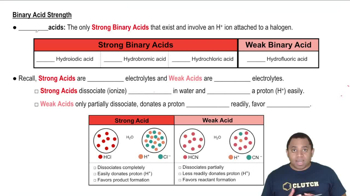
Binary Acid Strengths
Percent Ionization
Percent ionization is a measure of the extent to which an acid ionizes in solution, expressed as a percentage. It is calculated using the formula: (concentration of ionized acid / initial concentration of acid) × 100%. This value helps compare the strength of acids at different concentrations, as it often varies with dilution.
Recommended video:
Guided course
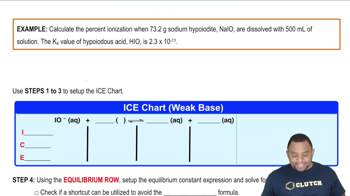
Percent Ionization Example
Equilibrium Concentrations
In the context of acid ionization, equilibrium concentrations refer to the concentrations of reactants and products at equilibrium in a chemical reaction. For weak acids like hydrazoic acid, the equilibrium expression involves the concentrations of the ionized species and the undissociated acid, allowing for the calculation of percent ionization and the use of the Ka value to find the equilibrium state.
Related Practice
Textbook Question
1107
views
Textbook Question
Citric acid, which is present in citrus fruits, is a triprotic acid (Table 16.3). (a) Calculate the pH of a 0.040 M solution of citric acid. (b) Did you have to make any approximations or assumptions in completing your calculations? (c) Is the concentration of citrate ion 1C6H5O7 3-2 equal to, less than, or greater than the H+ ion concentration?
1670
views
Textbook Question
Calculate the percent ionization of propionic acid (C2H5COOH) in solutions of each of the following concentrations (Ka is given in Appendix D): (a) 0.250 M (b) 0.0800 M (c) 0.0200 M
630
views
Textbook Question
Consider the base hydroxylamine, NH2OH. (a) What is the conjugate acid of hydroxylamine?
1199
views