
The probe of the pH meter shown here is sitting in a beaker that contains a clear liquid. You are told the liquid is pure water, a solution of HCl(aq), or a solution of KOH(aq). (b) If the liquid is one of the solutions, what is its molarity?
Ch.16 - Acid-Base Equilibria

Brown15th EditionChemistry: The Central ScienceISBN: 9780137542970Not the one you use?Change textbook
Chapter 16, Problem 2
For each of these reactions, identify the acid and base among the reactants, and state if the acids and bases are Lewis, Arrhenius, and/or Brønsted–Lowry: (a) PCl4^+ + Cl^- → PCl5 (b) NH3 + BF3 → H3NBF3 (c) [Al(H2O)6]^3+ + H2O → [Al(H2O)5OH]^2+ + H3O^+
Verified step by step guidance1
Step 1: For reaction (a) PCl4^+ + Cl^- → PCl5, identify the acid and base. PCl4^+ accepts an electron pair from Cl^-, forming PCl5. Therefore, PCl4^+ is the Lewis acid, and Cl^- is the Lewis base.
Step 2: For reaction (b) NH3 + BF3 → H3NBF3, identify the acid and base. NH3 donates an electron pair to BF3, forming a coordinate covalent bond. Thus, NH3 is the Lewis base, and BF3 is the Lewis acid.
Step 3: For reaction (c) [Al(H2O)6]^3+ + H2O → [Al(H2O)5OH]^2+ + H3O^+, identify the acid and base. [Al(H2O)6]^3+ donates a proton to H2O, forming [Al(H2O)5OH]^2+ and H3O^+. Therefore, [Al(H2O)6]^3+ is the Brønsted–Lowry acid, and H2O is the Brønsted–Lowry base.
Step 4: Classify the acids and bases in each reaction according to the definitions: Lewis acids and bases involve electron pair transfer, while Brønsted–Lowry acids and bases involve proton transfer.
Step 5: Note that Arrhenius definitions are not applicable here as they specifically involve the formation of H^+ and OH^- in aqueous solutions, which is not the case in these reactions.
Key Concepts
Here are the essential concepts you must grasp in order to answer the question correctly.
Acid-Base Theories
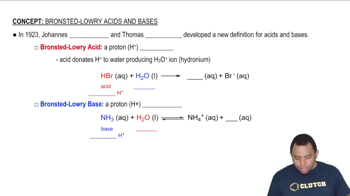
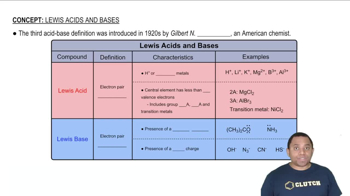
There are several theories that define acids and bases, the most notable being Arrhenius, Brønsted–Lowry, and Lewis. Arrhenius acids produce H+ ions in solution, while bases produce OH- ions. Brønsted–Lowry defines acids as proton donors and bases as proton acceptors. Lewis theory expands this definition, categorizing acids as electron pair acceptors and bases as electron pair donors. Understanding these theories is crucial for identifying the nature of reactants in acid-base reactions.
Recommended video:
Guided course
Bronsted-Lowry Acid-Base Theory
Lewis Acids and Bases
In Lewis theory, an acid is defined as a species that can accept an electron pair, while a base is one that can donate an electron pair. This concept is broader than the other theories, as it includes reactions that do not involve protons. For example, in the reaction between NH3 and BF3, NH3 acts as a Lewis base by donating an electron pair to BF3, which is a Lewis acid. Recognizing these roles is essential for analyzing the given reactions.
Recommended video:
Guided course
Lewis Acids and Bases
Proton Transfer Reactions
Proton transfer reactions are fundamental to Brønsted–Lowry acid-base theory, where acids donate protons (H+) and bases accept them. In the reaction involving [Al(H2O)6]^3+ and H2O, the aluminum complex acts as a Brønsted acid by donating a proton to water, forming hydroxide and hydronium ions. Identifying these proton transfers helps clarify the roles of reactants in acid-base reactions and their classifications under different theories.
Recommended video:
Guided course
Neutron-Proton Ratio
Related Practice
Textbook Question
1100
views
Textbook Question
The indicator methyl orange has been added to both of the following solutions. Based on the colors, classify each statement as true or false: (a) The pH of solution A is definitely less than 7.00. (b) The pH of solution B is definitely greater than 7.00. (c) The pH of solution B is greater than that of solution A.
672
views
Textbook Question
The following diagrams represent aqueous solutions of three acids, HX, HY, and HZ. The water molecules have been omitted for clarity, and the hydrated proton is represented as H+ rather than H3O+. (a) Which of the acids is a strong acid? Explain.
588
views
