
Atmospheric CO2 levels have risen by nearly 20% over the past 40 years from 320 ppm to 400 ppm. (a) Given that the average pH of clean, unpolluted rain today is 5.4, determine the pH of unpolluted rain 40 years ago. Assume that carbonic acid 1H2CO32 formed by the reaction of CO2 and water is the only factor influencing pH. CO21g2 + H2O1l2 Δ H2CO31aq2
Ch.16 - Acid-Base Equilibria

Brown15th EditionChemistry: The Central ScienceISBN: 9780137542970Not the one you use?Change textbook
Chapter 16, Problem 113b
The amino acid glycine (H2N–CH2–COOH) can participate in the following equilibria in water:
H2N–CH2–COOH + H2O ⇌ H2N–CH2–COO– + H3O+ Ka = 4.3 × 10⁻³
H2N–CH2–COOH + H2O⇌ +H3N–CH2–COOH + OH- Kb = 6.0 × 10⁻⁵
(b) What is the pH of a 0.050 M aqueous solution of glycine?
Verified step by step guidance1
Identify the relevant equilibria for glycine in water: the acid dissociation (Ka) and the base dissociation (Kb).
Recognize that glycine can act as both an acid and a base, making it an amphoteric species. Use the given Ka and Kb values to determine which equilibrium will dominate in a 0.050 M solution.
Calculate the concentration of hydronium ions \([H_3O^+]\) using the acid dissociation constant \(K_a\) and the initial concentration of glycine. Use the expression: \[ K_a = \frac{[H_3O^+][H_2N-CH_2-COO^-]}{[H_2N-CH_2-COOH]} \]
Assume that the change in concentration of glycine due to dissociation is small compared to the initial concentration, allowing simplification of the equilibrium expression.
Calculate the pH from the hydronium ion concentration using the formula: \( \text{pH} = -\log[H_3O^+] \).

Verified video answer for a similar problem:
This video solution was recommended by our tutors as helpful for the problem above.
Video duration:
7mWas this helpful?
Key Concepts
Here are the essential concepts you must grasp in order to answer the question correctly.
Acid-Base Equilibria
Acid-base equilibria involve the transfer of protons (H+) between species in solution. In the case of glycine, it can act as both an acid and a base, participating in equilibria that define its behavior in water. Understanding the dissociation constants (Ka and Kb) is crucial for predicting the pH of the solution, as they indicate the strength of the acid and base forms of glycine.
Recommended video:
Guided course
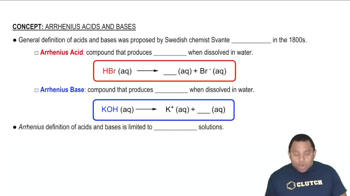
Arrhenius Acids and Bases
Dissociation Constants (Ka and Kb)
Dissociation constants, Ka and Kb, quantify the extent to which an acid or base dissociates in water. Ka represents the equilibrium constant for the dissociation of an acid, while Kb represents the equilibrium constant for the dissociation of a base. For glycine, the given values of Ka and Kb allow us to calculate the concentrations of the various species in solution, which is essential for determining the pH.
Recommended video:
Guided course
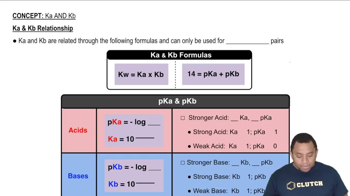
Ka and Kb Relationship
pH Calculation
pH is a measure of the hydrogen ion concentration in a solution, calculated using the formula pH = -log[H+]. In the context of glycine, the pH can be determined by considering the contributions of both the acidic and basic forms of the amino acid in solution. By applying the Henderson-Hasselbalch equation or directly using the dissociation constants, one can find the pH of the glycine solution.
Recommended video:
Guided course
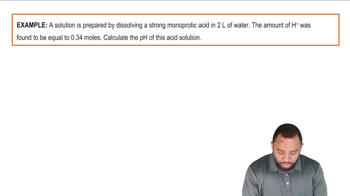
pH Calculation Example
Related Practice
Textbook Question
427
views
Textbook Question
The following observations are made about a diprotic acid H2A: (i) A 0.10 M solution of H2A has pH = 3.30. (ii) A 0.10 M solution of the salt NaHA is acidic. Which of the following could be the value of pKa2 for H2A: (i) 3.22, (ii) 5.30, (iii) 7.47, or (iv) 9.82?
919
views
Textbook Question
The amino acid glycine (H2N–CH2–COOH) can participate in the following equilibria in water:
H2N–CH2–COOH + H2O ⇌ H2N–CH2–COO– + H3O+ Ka = 4.3 × 10⁻³
H2N–CH2–COOH + H2O⇌ +H3N–CH2–COOH + OH- Kb = 6.0 × 10⁻⁵
(a) Use the values of Ka and Kb to estimate the equilibrium constant for the intramolecular proton transfer to form a zwitterion: H2N–CH2–COOH ⇌ +H3N–CH2–COO–
886
views
