Write the chemical equation and the Kb expression for the reaction of each of the following bases with water: (a) propylamine, C3H7NH2
Ch.16 - Acid-Base Equilibria

Brown15th EditionChemistry: The Central ScienceISBN: 9780137542970Not the one you use?Change textbook
Chapter 16, Problem 72a
The hypochlorite ion, ClO-, acts as a weak base. (a) Is ClO- a stronger or weaker base than hydroxylamine?
Verified step by step guidance1
Step 1: To determine whether ClO- is a stronger or weaker base than hydroxylamine, we need to compare their base ionization constants (Kb).
Step 2: The base ionization constant (Kb) is a measure of the strength of a base. The larger the Kb, the stronger the base.
Step 3: Look up the Kb values for ClO- and hydroxylamine in a table of ionization constants. These values can be found in a chemistry textbook or reliable online source.
Step 4: Compare the Kb values. If the Kb of ClO- is larger than that of hydroxylamine, then ClO- is a stronger base. If the Kb of ClO- is smaller, then it is a weaker base.
Step 5: Remember that the strength of a base is also related to the stability of its conjugate acid. A base that has a more stable conjugate acid will be weaker because it is less likely to accept a proton.

Verified video answer for a similar problem:
This video solution was recommended by our tutors as helpful for the problem above.
Video duration:
1mWas this helpful?
Key Concepts
Here are the essential concepts you must grasp in order to answer the question correctly.
Acid-Base Theory
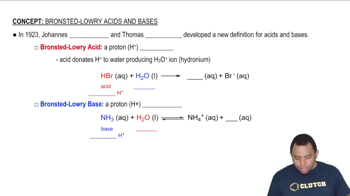
Acid-base theory explains the behavior of substances in terms of proton (H+) transfer. According to the Brønsted-Lowry theory, acids donate protons while bases accept them. Understanding this concept is crucial for comparing the basicity of different species, such as the hypochlorite ion (ClO-) and hydroxylamine.
Recommended video:
Guided course
Bronsted-Lowry Acid-Base Theory
Weak Bases
Weak bases are substances that do not completely dissociate in solution to produce hydroxide ions (OH-). Instead, they establish an equilibrium between the undissociated base and its ions. The strength of a weak base can be assessed by its base dissociation constant (Kb), which indicates its ability to accept protons compared to other weak bases.
Recommended video:
Guided course
ICE Charts of Weak Bases
Comparative Basicity
Comparative basicity involves evaluating the strength of different bases based on their ability to accept protons. This can be determined by examining their Kb values or their conjugate acids' stability. In this context, comparing ClO- with hydroxylamine requires analyzing their respective structures and the stability of their conjugate acids to conclude which is the stronger base.
Related Practice
Textbook Question
752
views
Textbook Question
Citric acid, which is present in citrus fruits, is a triprotic acid (Table 16.3). (a) Calculate the pH of a 0.040 M solution of citric acid. (b) Did you have to make any approximations or assumptions in completing your calculations? (c) Is the concentration of citrate ion 1C6H5O7 3-2 equal to, less than, or greater than the H+ ion concentration?
1670
views
Textbook Question
Calculate the percent ionization of propionic acid (C2H5COOH) in solutions of each of the following concentrations (Ka is given in Appendix D): (a) 0.250 M (b) 0.0800 M (c) 0.0200 M
630
views
Textbook Question
Consider the base hydroxylamine, NH2OH. (a) What is the conjugate acid of hydroxylamine?
1199
views