(a) For a process that occurs at constant temperature, does the change in Gibbs free energy depend on changes in the enthalpy and entropy of the system?
Ch.19 - Chemical Thermodynamics

Brown15th EditionChemistry: The Central ScienceISBN: 9780137542970Not the one you use?Change textbook
Chapter 19, Problem 55b
For a certain chemical reaction, ΔH° = -35.4 kJ and ΔS° = -85.5 J/K. (b) Does the reaction lead to an increase or decrease in the randomness or disorder of the system?
Verified step by step guidance1
Identify the given entropy change, ΔS°, which is -85.5 J/K.
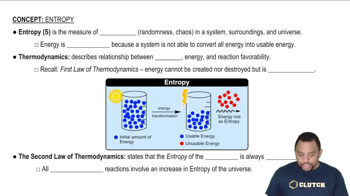
Understand that entropy, represented by 'S', is a measure of the randomness or disorder of a system.
Recognize that a negative ΔS° indicates a decrease in entropy.
Conclude that if ΔS° is negative, the randomness or disorder of the system decreases during the reaction.
Thus, the reaction leads to a decrease in the randomness or disorder of the system.

Verified video answer for a similar problem:
This video solution was recommended by our tutors as helpful for the problem above.
Video duration:
2mWas this helpful?
Key Concepts
Here are the essential concepts you must grasp in order to answer the question correctly.
Enthalpy (ΔH)
Enthalpy is a measure of the total energy of a thermodynamic system, often associated with heat transfer during a reaction at constant pressure. A negative ΔH indicates that the reaction is exothermic, meaning it releases heat to the surroundings. This can influence the spontaneity of a reaction, as exothermic reactions tend to favor product formation.
Entropy (ΔS)
Entropy is a measure of the disorder or randomness in a system. A negative ΔS indicates that the reaction leads to a decrease in disorder, meaning the products are more ordered than the reactants. Understanding entropy is crucial for predicting the spontaneity of reactions, as systems tend to evolve towards higher entropy.
Recommended video:
Guided course
Entropy in Thermodynamics
Gibbs Free Energy (ΔG)
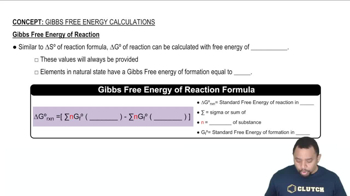
Gibbs Free Energy combines enthalpy and entropy to determine the spontaneity of a reaction at constant temperature and pressure. The relationship is given by the equation ΔG = ΔH - TΔS. A negative ΔG indicates that a reaction is spontaneous, while a positive ΔG suggests non-spontaneity. In this case, the signs of ΔH and ΔS will help assess the overall spontaneity.
Recommended video:
Guided course
Gibbs Free Energy of Reactions
Related Practice
Textbook Question
869
views
Textbook Question
Use data in Appendix C to calculate ΔH°, ΔS°, and ΔG° at 25 °C for each of the following reactions.
a. 4 Cr(s) + 3 O2(g) → 2 Cr2O3(s)
b. BaCO3(s) → BaO(s) + CO2(g)
c. 2 P(s) + 10 HF(g) → 2 PF5(g) + 5 H2(g)
d. K(s) + O2(g) → KO2(s)
2561
views
Textbook Question
Using S° values from Appendix C, calculate ΔS° values for the following reactions. In each case, account for the sign of ΔS°.
(a) C2H4(g) + H2(g) → C2H6(g)
(b) N2O4(g) → 2 NO2(g)
(c) Be(OH)2(s) → BeO(s) + H2O(g)
(d) 2 CH3OH(g) + 3 O2(g) ⟶ 2 CO2(g) + 4 H2O(g)
1507
views
Textbook Question
For a certain chemical reaction, ΔH° = -35.4 kJ and ΔS° = -85.5 J/K. (c) Calculate ΔG° for the reaction at 298 K. (d) Is the reaction spontaneous at 298 K under standard conditions?