Consider the decomposition of barium carbonate: BaCO3(s) ⇌ BaO(s) + CO2(g) Using data from Appendix C, calculate the equilibrium pressure of CO2 at (b) 1100 K.
Ch.19 - Chemical Thermodynamics

Brown15th EditionChemistry: The Central ScienceISBN: 9780137542970Not the one you use?Change textbook
Chapter 19, Problem 83a
The value of Ka for nitrous acid (HNO2) at 25 °C is given in Appendix D. (a) Write the chemical equation for the equilibrium that corresponds to Ka.
Verified step by step guidance1
Identify the chemical formula for nitrous acid, which is HNO2.
Recognize that the dissociation of an acid in water typically results in the formation of hydrogen ions (H+) and the conjugate base of the acid.
Write the chemical equation for the dissociation of nitrous acid in water: HNO2(aq) ⇌ H+(aq) + NO2-(aq).
Understand that Ka, the acid dissociation constant, quantifies the strength of the acid in solution, indicating how completely the acid dissociates in water.
The equilibrium expression corresponding to this reaction is Ka = [H+][NO2-] / [HNO2], where the concentrations are those at equilibrium.

Verified video answer for a similar problem:
This video solution was recommended by our tutors as helpful for the problem above.
Video duration:
1mWas this helpful?
Key Concepts
Here are the essential concepts you must grasp in order to answer the question correctly.
Acid-Base Equilibrium
Acid-base equilibrium refers to the state in which the concentrations of the reactants and products in an acid-base reaction remain constant over time. For weak acids like nitrous acid (HNO2), this equilibrium involves the dissociation of the acid into its ions, which is characterized by the acid dissociation constant (Ka). Understanding this concept is crucial for writing the correct equilibrium expression.
Recommended video:
Guided course
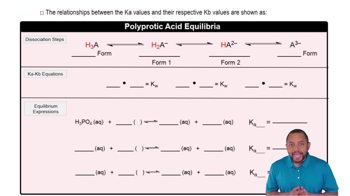
Triprotic Acid Equilibrium
Acid Dissociation Constant (Ka)
The acid dissociation constant (Ka) quantifies the strength of an acid in solution. It is defined as the ratio of the concentration of the products (the dissociated ions) to the concentration of the undissociated acid at equilibrium. A higher Ka value indicates a stronger acid that dissociates more completely in solution, which is essential for determining the behavior of HNO2 in aqueous solutions.
Recommended video:
Guided course
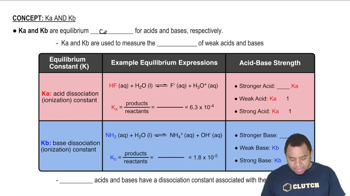
Characteristics of Ka and Kb
Chemical Equations and Equilibrium Expressions
Chemical equations represent the reactants and products involved in a chemical reaction, while equilibrium expressions mathematically describe the relationship between the concentrations of these species at equilibrium. For HNO2, the equilibrium equation would show the dissociation into H+ and NO2-, allowing for the calculation of Ka. Writing these equations correctly is fundamental for analyzing acid-base reactions.
Recommended video:
Guided course
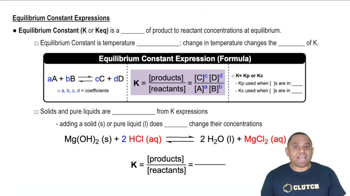
Equilibrium Constant Expressions
Related Practice
Textbook Question
666
views
Textbook Question
The value of Ka for nitrous acid (HNO2) at 25 °C is given in Appendix D. (b) By using the value of Ka, calculate ΔG° for the dissociation of nitrous acid in aqueous solution.
278
views
Textbook Question
Consider the decomposition of barium carbonate: BaCO3(s) ⇌ BaO(s) + CO2(g) Using data from Appendix C, calculate the equilibrium pressure of CO2 at (a) 298 K.
1184
views
2
rank
Textbook Question
The value of Ka for nitrous acid (HNO2) at 25 °C is given in Appendix D. (c) What is the value of ΔG at equilibrium?
258
views
Textbook Question
The value of Ka for nitrous acid (HNO2) at 25 °C is given in Appendix D. (d) What is the value of ΔG when [H+] = 5.0⨉10-2 M, [NO2-] = 6.0⨉10-4 M, and [HNO2] = 0.20 M?
351
views