Ch.2 - Atoms, Molecules, and Ions
Brown - Chemistry: The Central Science 15th Edition
Brown15th EditionChemistry: The Central ScienceISBN: 9780137542970Not the one you use?Change textbook
Chapter 2, Problem 31b,c

Write the correct symbol, with both superscript and subscript, for each of the following. Use the list of elements in the front inside cover as needed: (b) the isotope of krypton with mass number 84 (c) the isotope of rhenium with mass number 187

Verified step by step guidance
1
Identify the element symbol for krypton, which is 'Kr'.
Understand that the mass number is the total number of protons and neutrons in the nucleus of an atom.
The mass number is given as 84, which will be the superscript to the left of the element symbol.
Determine the atomic number of krypton, which is the number of protons. Krypton has an atomic number of 36.
Write the isotope notation with the mass number as the superscript and the atomic number as the subscript: \( ^{84}_{36} \text{Kr} \).

Verified video answer for a similar problem:

This video solution was recommended by our tutors as helpful for the problem above.
Video duration:
1m
Was this helpful?

Key Concepts

Here are the essential concepts you must grasp in order to answer the question correctly.

Isotopes

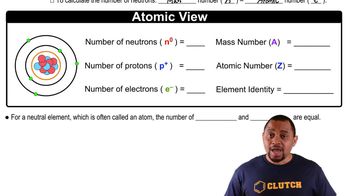
Isotopes are variants of a particular chemical element that have the same number of protons but different numbers of neutrons. This difference in neutron count results in varying mass numbers for the isotopes. For example, krypton (Kr) has several isotopes, and the mass number indicates the total number of protons and neutrons in the nucleus.
Recommended video:

Nuclear Notation

Nuclear notation is a way of representing isotopes using the element's symbol, with the mass number as a superscript and the atomic number as a subscript. The atomic number indicates the number of protons, while the mass number represents the total number of protons and neutrons. For krypton with a mass number of 84, the notation would be written as 84Kr.
Recommended video:
Guided course
02:50
Standard Notation to Scientific Notation

Element Symbols

Element symbols are one- or two-letter abbreviations used to represent chemical elements on the periodic table. Each element has a unique symbol, often derived from its English or Latin name. For krypton, the symbol is 'Kr', which is essential for correctly writing its nuclear notation when identifying isotopes.
Recommended video:
Guided course
03:17
Lewis Dot Symbols
Related Practice
Textbook Question

Fill in the gaps in the following table, assuming each column represents a neutral atom.

Symbol 112Cd

Protons 38 92

Neutrons 58 49

Electrons 38 36

Mass no. 81 235

Complete the second row of the table.

1238
views

Textbook Question

Write the correct symbol, with both superscript and subscript, for each of the following. Use the list of elements in the front inside cover as needed: (d) the isotope of magnesium that has an equal number of protons and neutrons.

554
views
Textbook Question

Write the correct symbol, with both superscript and subscript, for each of the following. Use the list of elements in the front inside cover as needed: (a) the isotope of platinum that contains 118 neutrons

816
views
Textbook Question

Fill in the gaps in the following table, assuming each column represents a neutral atom.

Symbol 112Cd

Protons 38 92

Neutrons 58 49

Electrons 38 36

Mass no. 81 235

Complete the first row of the table.

484
views
Textbook Question

Only two isotopes of copper occur naturally: 63Cu (atomic mass = 62.9296 amu; abundance 69.17%) 65Cu (atomic mass = 64.9278 amu; abundance 30.83%). Calculate the atomic weight (average atomic mass) of copper.

4359
views
Textbook Question

The atomic weight of boron is reported as 10.81, yet no atom of boron has the mass of 10.81 amu. Which is the best explanation?

a. The measurement of atomic mass is only reliable to two significant figures.

b. The atomic weight is an average of many individual atoms.

c. The atomic weight is an average of many isotopes of the same nuclear composition.