
A voltaic cell is constructed that is based on the following reaction: Sn2+(aq) + Pb(s) → Sn(s) + Pb2+(aq) (a) If the concentration of Sn2+ in the cathode half-cell is 1.00 M and the cell generates an emf of +0.22 V, what is the concentration of Pb2+ in the anode half-cell?
Ch.20 - Electrochemistry

Brown15th EditionChemistry: The Central ScienceISBN: 9780137542970Not the one you use?Change textbook
Chapter 20, Problem 71b
A voltaic cell utilizes the following reaction: 4 Fe2+1aq2 + O21g2 + 4 H+1aq2 ¡ 4 Fe3+1aq2 + 2 H2O1l2 (b) What is the emf of this cell when 3Fe2+4 = 1.3 M, 3Fe3+4= 0.010 M, PO2 = 0.50 atm, and the pH of the solution in the cathode half-cell is 3.50?
Verified step by step guidance1
Identify the half-reactions for the cathode and anode. For the given reaction, the oxidation at the anode is: \(4 \text{Fe}^{2+} \rightarrow 4 \text{Fe}^{3+} + 4e^-\) and the reduction at the cathode is: \(\text{O}_2 + 4 \text{H}^+ + 4e^- \rightarrow 2 \text{H}_2\text{O}\).
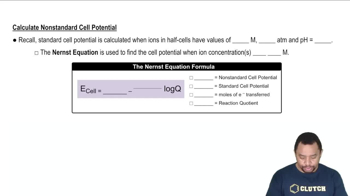
Write the Nernst equation for the overall cell reaction. The Nernst equation is given by: \(E = E^\circ - \frac{0.0592}{n} \log Q\), where \(E^\circ\) is the standard cell potential, \(n\) is the number of moles of electrons transferred, and \(Q\) is the reaction quotient.
Calculate the reaction quotient, \(Q\), using the given concentrations and pressures. For the reaction, \(Q = \frac{[\text{Fe}^{3+}]^4 \cdot (\text{P}_{\text{O}_2})^{1/2}}{[\text{Fe}^{2+}]^4 \cdot [\text{H}^+]^4}\). Substitute the values \([\text{Fe}^{2+}] = 1.3 \text{ M}\), \([\text{Fe}^{3+}] = 0.010 \text{ M}\), \(\text{P}_{\text{O}_2} = 0.50 \text{ atm}\), and \([\text{H}^+] = 10^{-3.50} \text{ M}\) into the equation.
Determine the number of electrons transferred, \(n\), in the balanced equation. From the half-reactions, you can see that 4 electrons are transferred.
Substitute the values into the Nernst equation to find the emf of the cell. Remember to use the standard emf, \(E^\circ\), for the reaction which can be found in standard reduction potential tables.

Verified video answer for a similar problem:
This video solution was recommended by our tutors as helpful for the problem above.
Video duration:
12mWas this helpful?
Key Concepts
Here are the essential concepts you must grasp in order to answer the question correctly.
Electrochemical Cells
Electrochemical cells, such as voltaic cells, convert chemical energy into electrical energy through redox reactions. In these cells, oxidation occurs at the anode and reduction at the cathode, allowing for the flow of electrons through an external circuit. Understanding the components and functioning of these cells is essential for calculating their electromotive force (emf).
Nernst Equation
The Nernst equation relates the cell potential (emf) to the concentrations of the reactants and products involved in the electrochemical reaction. It accounts for non-standard conditions by incorporating the reaction quotient and temperature, allowing for the calculation of emf under varying concentrations and pressures. This equation is crucial for determining the emf in the given voltaic cell scenario.
Recommended video:
Guided course
The Nernst Equation
pH and Hydrogen Ion Concentration
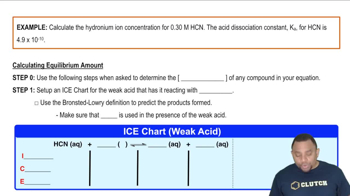
pH is a measure of the hydrogen ion concentration in a solution, which influences the equilibrium of redox reactions in electrochemical cells. In the context of the given question, the pH of the cathode half-cell affects the concentration of H+ ions, thereby impacting the overall cell potential. Understanding the relationship between pH and hydrogen ion concentration is vital for accurate emf calculations.
Recommended video:
Guided course
Hydronium Ion Concentration Example
Related Practice
Textbook Question
936
views
Textbook Question
A voltaic cell utilizes the following reaction: Al1s2 + 3 Ag+1aq2 ¡ Al3+1aq2 + 3 Ag1s2 What is the effect on the cell emf of each of the following changes? (a) Water is added to the anode half-cell, diluting the solution.
836
views
Textbook Question
A voltaic cell utilizes the following reaction: (b) What is the emf for this cell when 3Fe3+4 = 3.50 M, PH2= 0.95 atm, 3Fe2+4 = 0.0010 M, and the pH in both half-cells is 4.00?
1012
views
1
comments
Textbook Question
A voltaic cell utilizes the following reaction: 2 Fe3+1aq2 + H21g2 ¡ 2 Fe2+1aq2 + 2 H+1aq2 (a) What is the emf of this cell under standard conditions?
457
views
