
Complete and balance the following equations, and identify the oxidizing and reducing agents. (Recall that the O atoms in hydrogen peroxide, H2O2, have an atypical oxidation state.) H2O21aq2 + ClO21aq2 ¡ ClO2-1aq2 + O21g2 (basic solution)
Ch.20 - Electrochemistry

Brown15th EditionChemistry: The Central ScienceISBN: 9780137542970Not the one you use?Change textbook
Chapter 20, Problem 35a
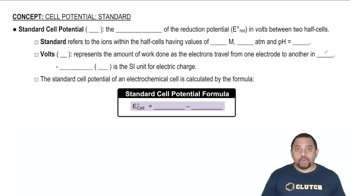
(a) What is the definition of the volt?
Verified step by step guidance1
The volt (V) is the derived unit for electric potential, electric potential difference (voltage), and electromotive force in the International System of Units (SI).
One volt is defined as the potential difference across a conductor when a current of one ampere dissipates one watt of power.
Mathematically, the relationship can be expressed as: \( 1 \text{ V} = 1 \text{ W/A} \), where W is watts and A is amperes.
In terms of basic SI units, a volt is equivalent to one joule per coulomb: \( 1 \text{ V} = 1 \text{ J/C} \).
This means that one volt is the potential difference that will move one coulomb of charge with an energy of one joule.

Verified video answer for a similar problem:
This video solution was recommended by our tutors as helpful for the problem above.
Video duration:
3mWas this helpful?
Key Concepts
Here are the essential concepts you must grasp in order to answer the question correctly.
Definition of Volt
The volt (V) is the SI unit of electric potential difference, electric potential, and electromotive force. It is defined as the potential difference that will move one coulomb of charge through an electric circuit with one joule of energy. Essentially, it quantifies how much energy is available to push electric charges through a conductor.
Electric Potential Difference
Electric potential difference, or voltage, refers to the difference in electric potential between two points in a circuit. It indicates the work done per unit charge to move a charge from one point to another. This concept is fundamental in understanding how electric circuits function and how energy is transferred within them.
Recommended video:
Guided course
Standard Cell Potential
Coulomb and Joule
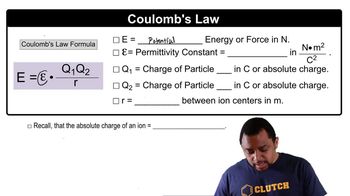
The coulomb (C) is the unit of electric charge, while the joule (J) is the unit of energy. Understanding these units is crucial for grasping the definition of a volt, as it relates to the amount of charge moved and the energy expended. One volt is equivalent to one joule per coulomb, illustrating the relationship between energy and charge in electrical systems.
Recommended video:
Guided course
Coulomb's Law Concept 2
Related Practice
Textbook Question
491
views
Textbook Question
Complete and balance the following equations, and identify the oxidizing and reducing agents: As2O3(s) + NO3-(aq) → H3AsO4(aq) + N2O3(aq) (acidic solution)
430
views
Textbook Question
(b) Write the half-reaction that occurs at a hydrogen electrode in acidic aqueous solution when it serves as the anode of a voltaic cell.
379
views
Textbook Question
A voltaic cell similar to that shown in Figure 20.5 is constructed. One electrode half-cell consists of a silver strip placed in a solution of AgNO3, and the other has an iron strip placed in a solution of FeCl2. The overall cell reaction is Fe1s2 + 2 Ag+1aq2 ¡ Fe2+1aq2 + 2 Ag1s2 (f) In which directions do the cations and anions migrate through the solution?
734
views
Textbook Question
(b) Do all voltaic cells produce a positive cell potential?
500
views
