
Complete and balance the following equations, and identify the oxidizing and reducing agents. (Recall that the O atoms in hydrogen peroxide, H2O2, have an atypical oxidation state.) H2O21aq2 + ClO21aq2 Β‘ ClO2-1aq2 + O21g2 (basic solution)

Complete and balance the following equations, and identify the oxidizing and reducing agents:
a. MnO4β(ππ)+CH3OH(ππ)βΆMn2+(ππ)+HCOOH(ππ)(acidic solution)
b. As2O3(π )+NO3β(ππ)βΆH3AsO4(ππ)+N2O3(ππ)(acidic solution)
c. Pb(OH)42β(ππ)+ClOβ(ππ)βΆPbO2(π )+Clβ(ππ)(basic solution)
Verified step by step guidance
Verified video answer for a similar problem:
Key Concepts
Redox Reactions
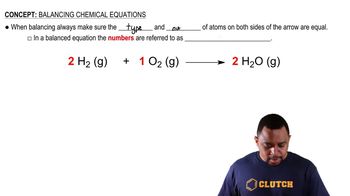
Balancing Chemical Equations
Oxidizing and Reducing Agents
Complete and balance the following equations, and identify the oxidizing and reducing agents: As2O3(s) + NO3-(aq) β H3AsO4(aq) + N2O3(aq) (acidic solution)
A voltaic cell similar to that shown in Figure 20.5 is constructed. One electrode half-cell consists of a silver strip placed in a solution of AgNO3, and the other has an iron strip placed in a solution of FeCl2. The overall cell reaction is Fe1s2 + 2 Ag+1aq2 Β‘ Fe2+1aq2 + 2 Ag1s2 (f) In which directions do the cations and anions migrate through the solution?
Complete and balance the following equations, and identify the oxidizing and reducing agents: (a) Cr2O72-(aq) + I-(aq) β Cr3+(aq) + IO3-(aq) (acidic solution) (b) MnO4-(aq) + CH3O(1aq) β Mn2+(aq) + HCOOH(aq) (acidic solution) (c) I2(s) + OCl-(aq) β IO3-(aq) + Cl-(aq) (acidic solution)
Complete and balance the following half-reactions in basic solution. In each case, indicate whether the half-reaction is an oxidation or a reduction. c. Cr(OH)3(π )βΆCrO42β(ππ)
Complete and balance the following equations, and identify the oxidizing and reducing agents: MnO4-(aq) + Br-(aq) β MnO2(s) + BrO3-(aq) (basic solution)
