
Ch.21 - Nuclear Chemistry
Brown - Chemistry: The Central Science 15th Edition
Brown15th EditionChemistry: The Central ScienceISBN: 9780137542970Not the one you use?Change textbook
Chapter 21, Problem 72

Radon-222 decays to a stable nucleus by a series of three alpha emissions and two beta emissions. What is the stable nucleus that is formed?

Verified step by step guidance
1
Identify the initial nucleus: Radon-222 (\(^{222}_{86}\text{Rn}\)).
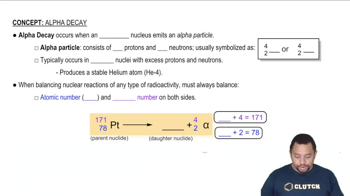
Understand that an alpha particle emission reduces the atomic number by 2 and the mass number by 4. Therefore, three alpha emissions will reduce the atomic number by 6 and the mass number by 12.
Calculate the new atomic number and mass number after three alpha emissions: \(^{222}_{86}\text{Rn} \rightarrow ^{210}_{80}\text{X}\).
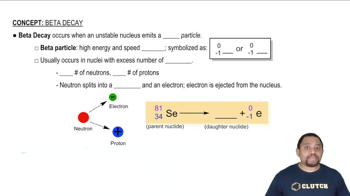
Recognize that a beta particle emission increases the atomic number by 1 without changing the mass number. Therefore, two beta emissions will increase the atomic number by 2.
Calculate the final atomic number and mass number after two beta emissions: \(^{210}_{80}\text{X} \rightarrow ^{210}_{82}\text{Pb}\). The stable nucleus formed is Lead-210 (\(^{210}_{82}\text{Pb}\)).

Verified video answer for a similar problem:

This video solution was recommended by our tutors as helpful for the problem above.
Video duration:
5m
Was this helpful?

Key Concepts

Here are the essential concepts you must grasp in order to answer the question correctly.

Alpha Decay

Alpha decay is a type of radioactive decay in which an unstable nucleus emits an alpha particle, consisting of two protons and two neutrons. This process decreases the atomic number by two and the mass number by four, leading to the formation of a new element. Understanding alpha decay is crucial for tracking the changes in the nucleus during the decay process.
Recommended video:

Beta Decay

Beta decay occurs when a neutron in an unstable nucleus is transformed into a proton, emitting a beta particle (an electron or positron) in the process. This increases the atomic number by one while keeping the mass number unchanged. Recognizing how beta decay alters the composition of the nucleus is essential for determining the final stable nucleus after multiple decay events.
Recommended video:

Nuclear Stability

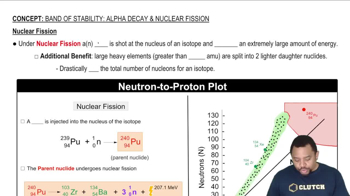
Nuclear stability refers to the ability of a nucleus to remain intact without undergoing radioactive decay. Stable nuclei have balanced ratios of protons to neutrons, which minimizes repulsive forces between protons. Identifying the stable nucleus formed after a series of decays requires understanding the stability criteria and the resulting changes in atomic and mass numbers from the decay processes.
Recommended video:
Guided course
03:29
Band of Stability: Nuclear Fission
Related Practice
Textbook Question

Chlorine has two stable nuclides, 35Cl and 37Cl. In contrast, 36Cl is a radioactive nuclide that decays by beta emission. (b) Based on the empirical rules about nuclear stability, explain why the nucleus of 36Cl is less stable than either 35Cl or 37Cl.

Textbook Question

A laboratory rat is exposed to an alpha-radiation source whose activity is 14.3 mCi. (a) What is the activity of the radiation in disintegrations per second? In becquerels?

512
views
Textbook Question

The table provided gives the number of protons (p) and neutrons (n) for four isotopes, identified only as (i)–(iv). a. Write the symbol for each of the isotopes.

Textbook Question

A laboratory rat is exposed to an alpha-radiation source whose activity is 14.3 mCi. (b) The rat has a mass of 385 g and is exposed to the radiation for 14.0 s, absorbing 35% of the emitted alpha particles, each having an energy of 9.12 * 10-13 J. Calculate the absorbed dose in millirads and grays.

99
views
Textbook Question

Nuclear scientists have synthesized approximately 1600 nuclei not known in nature. More might be discovered with heavy-ion bombardment using high-energy particle accelerators. Complete and balance the following reactions, which involve heavy-ion bombardments:

(a) 63Li + 5628Ni → ?

(b) 4020Ca + 24896Cm → 14762Sm + ?

(c) 8838Sr + 8436Kr → 11646Pd + ?

(d) 4020Ca + 23892U → 7030Zn + 4 10n + 2 ?

344
views
Textbook Question

In 2010, a team of scientists from Russia and the United States reported creation of the first atom of element 117, which is named tennessine, and whose symbol is Ts. The synthesis involved the collision of a target of 24997Bk with accelerated ions of an isotope which we will denote Q. The product atom, which we will call Z, immediately releases neutrons and forms 294117Ts: 24997Bk + Q → Z → 294117Ts + 3 10n (a) What are the identities of isotopes Q and Z? (c) Collision of ions of isotope Q with a target was also used to produce the first atoms of livermorium, Lv. The initial product of this collision was 296116Lv. What was the target isotope with which Q collided in this experiment?