Give the empirical formula of each of the following compounds if a sample contains b.11.66 g iron and 5.01 g oxygen
Ch.3 - Chemical Reactions and Reaction Stoichiometry

Brown15th EditionChemistry: The Central ScienceISBN: 9780137542970Not the one you use?Change textbook
Chapter 3, Problem 46b
Determine the empirical formula of each of the following compounds if a sample contains b. 5.28 g Sn and 3.37 g F;
Verified step by step guidance1
Identify the elements present in the compound: Tin (Sn) and Fluorine (F).
Convert the mass of each element to moles by dividing by their respective molar masses: \( \text{Molar mass of Sn} = 118.71 \, \text{g/mol} \) and \( \text{Molar mass of F} = 19.00 \, \text{g/mol} \).
Calculate the moles of Sn: \( \frac{5.28 \, \text{g}}{118.71 \, \text{g/mol}} \).
Calculate the moles of F: \( \frac{3.37 \, \text{g}}{19.00 \, \text{g/mol}} \).
Determine the simplest whole number ratio of moles of Sn to moles of F by dividing each by the smallest number of moles calculated.

Verified video answer for a similar problem:
This video solution was recommended by our tutors as helpful for the problem above.
Video duration:
1mWas this helpful?
Key Concepts
Here are the essential concepts you must grasp in order to answer the question correctly.
Empirical Formula
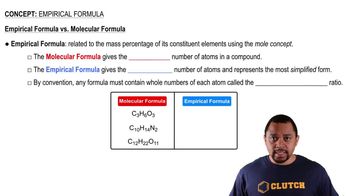
The empirical formula of a compound represents the simplest whole-number ratio of the elements present in that compound. It is derived from the relative amounts of each element, typically expressed in grams, and is calculated by converting these masses to moles and then simplifying the ratio.
Recommended video:
Guided course
Empirical vs Molecular Formula
Molar Mass
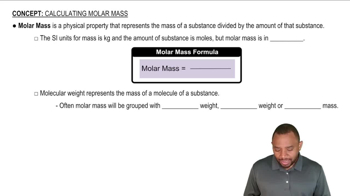
Molar mass is the mass of one mole of a substance, usually expressed in grams per mole (g/mol). It is essential for converting the mass of each element in a sample to moles, which is a necessary step in determining the empirical formula. For example, the molar mass of tin (Sn) is approximately 118.71 g/mol, and for fluorine (F), it is about 19.00 g/mol.
Recommended video:
Guided course
Molar Mass Concept
Stoichiometry
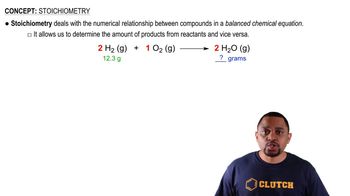
Stoichiometry is the area of chemistry that deals with the quantitative relationships between the reactants and products in a chemical reaction. In the context of finding an empirical formula, stoichiometry allows us to calculate the number of moles of each element from their masses, facilitating the determination of their simplest ratio.
Recommended video:
Guided course
Stoichiometry Concept
Related Practice
Textbook Question
3
views
Textbook Question
At least 25 mg of tetrahydrocannabinol (THC), the active ingredient in marijuana, is required to produce intoxication. The molecular formula of THC is C21H30O2. How many molecules?
1759
views
Textbook Question
Give the empirical formula of each of the following compounds if a sample contains a.0.0130 mol C, 0.0390 mol H, and 0.0065 mol O
2
views
Textbook Question
Determine the empirical formulas of the compounds with the following compositions by mass: a. 55.3% K, 14.6% P, and 30.1% O
3
views
Textbook Question
Determine the empirical formula of each of the following compounds if a sample contains c. 87.5% N and 12.5% H by mass.
3
views
Textbook Question
Determine the empirical formulas of the compounds with the following compositions by mass: c. 62.1% C, 5.21% H, 12.1% N, and the remainder O
2
views