(a) Write 'true' or 'false' for each statement. (b) A mole of water has a mass of 18.0 g.
Ch.3 - Chemical Reactions and Reaction Stoichiometry

Brown15th EditionChemistry: The Central ScienceISBN: 9780137542970Not the one you use?Change textbook
Chapter 3, Problem 30b
(b) How many bromine atoms are present in one mole of 12C?
Verified step by step guidance1
Understand the concept of a mole: A mole is a unit in chemistry that represents \$6.022 \times 10^{23}$ entities (Avogadro's number).
Identify the substance in question: The problem asks about bromine atoms in one mole of \(^{12}\text{C}\), which is carbon-12.
Recognize that carbon-12 does not contain bromine atoms: Carbon-12 is a pure element consisting only of carbon atoms.
Conclude that since carbon-12 does not contain bromine, there are zero bromine atoms in one mole of \(^{12}\text{C}\).
Reaffirm the understanding that the question is testing knowledge of chemical composition and the definition of a mole.

Verified video answer for a similar problem:
This video solution was recommended by our tutors as helpful for the problem above.
Video duration:
1mWas this helpful?
Key Concepts
Here are the essential concepts you must grasp in order to answer the question correctly.
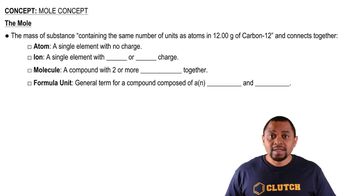
Mole Concept
The mole is a fundamental unit in chemistry that quantifies the amount of substance. One mole of any substance contains Avogadro's number of entities, which is approximately 6.022 x 10²³. This concept allows chemists to convert between the mass of a substance and the number of atoms, molecules, or ions it contains.
Recommended video:
Guided course
Mole Concept
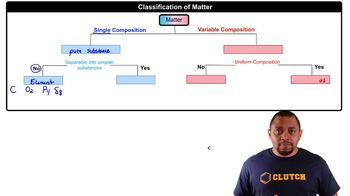
Atomic Composition
Atomic composition refers to the types and numbers of atoms that make up a molecule or compound. In the case of bromine, it is a diatomic molecule (Br₂) in its elemental form, meaning each molecule consists of two bromine atoms. Understanding atomic composition is crucial for determining the number of atoms in a given quantity of a substance.
Recommended video:
Guided course
Matter Composition
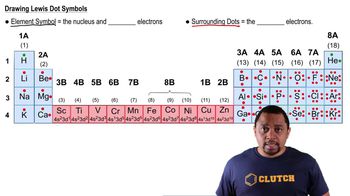
Chemical Symbols and Formulas
Chemical symbols and formulas are shorthand representations of elements and compounds. For example, 'Br' represents a bromine atom, while 'Br₂' indicates a molecule of bromine containing two bromine atoms. Recognizing these symbols is essential for interpreting chemical equations and understanding the relationships between different substances.
Recommended video:
Guided course
Lewis Dot Symbols
Related Practice
Textbook Question
669
views
Textbook Question
(a) Write 'true' or 'false' for each statement. (d) A mole of NaCl(s) contains 2 moles of ions
866
views
Textbook Question
(a) What is the mass, in grams, of one mole of 12C?
350
views
Textbook Question
Without doing any detailed calculations (but using a periodic table to give atomic weights), rank the following samples in order of increasing numbers of atoms: 0.50 mol H2O, 23 g Na, 6.0⨉1023 N2 molecules.
501
views
1
rank
Textbook Question
Without doing any detailed calculations (but using a periodic table to give atomic weights), rank the following samples in order of increasing numbers of atoms: 42 g of NaHCO3,1.5molCO2,6.0×1024 Ne atoms.
3
views
Textbook Question
What is the mass, in kilograms, of an Avogadro's number of people, if the average mass of a person is 160 lb?
862
views