Balance the following equations: c. NaHCO3(π )+H2SO4(ππ)βΆCO2(π)+H2O(π)+Na2SO4(ππ)
Ch.3 - Chemical Reactions and Reaction Stoichiometry

Brown15th EditionChemistry: The Central ScienceISBN: 9780137542970Not the one you use?Change textbook
Chapter 3, Problem 12d
Balance the following equations: d. AlCl3(π )+Ca3N2(π )βΆAlN(π )+CaCl2(π )
Verified step by step guidance1
Identify the number of each type of atom on both sides of the equation. For the reactants: AlCl_3 has 1 Al and 3 Cl, and Ca_3N_2 has 3 Ca and 2 N. For the products: AlN has 1 Al and 1 N, and CaCl_2 has 1 Ca and 2 Cl.
Start by balancing the metals. Balance the aluminum (Al) atoms first. Since there is 1 Al in AlCl_3 and 1 Al in AlN, they are already balanced.
Next, balance the calcium (Ca) atoms. There are 3 Ca atoms in Ca_3N_2, so you need 3 CaCl_2 to balance the Ca atoms on the product side.
Now, balance the nitrogen (N) atoms. There are 2 N atoms in Ca_3N_2, so you need 2 AlN to balance the N atoms on the product side.
Finally, balance the chlorine (Cl) atoms. You have 3 AlCl_3 providing 9 Cl atoms, and you need 3 CaCl_2 to provide 6 Cl atoms. Adjust the coefficients to ensure all atoms are balanced.

Verified video answer for a similar problem:
This video solution was recommended by our tutors as helpful for the problem above.
Video duration:
1mWas this helpful?
Key Concepts
Here are the essential concepts you must grasp in order to answer the question correctly.
Balancing Chemical Equations
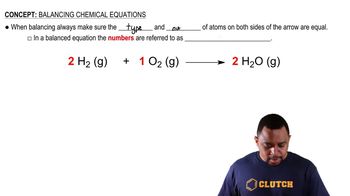
Balancing chemical equations involves ensuring that the number of atoms for each element is the same on both sides of the equation. This is based on the law of conservation of mass, which states that matter cannot be created or destroyed in a chemical reaction. Coefficients are used to adjust the quantities of reactants and products to achieve balance.
Recommended video:
Guided course
Balancing Chemical Equations
Types of Chemical Reactions
The reaction in the question is a double displacement reaction, where two compounds exchange ions to form new compounds. In this case, aluminum chloride reacts with calcium nitride to produce aluminum nitride and calcium chloride. Understanding the type of reaction helps predict the products and the balancing process.
Recommended video:
Guided course
Common Types of Alkane Reactions
State Symbols in Chemical Equations
State symbols indicate the physical state of the reactants and products in a chemical equation. Common symbols include (s) for solid, (l) for liquid, (g) for gas, and (aq) for aqueous solutions. These symbols provide important information about the conditions of the reaction and can influence the balancing process.
Recommended video:
Guided course
Balancing Chemical Equations
Related Practice
Textbook Question
2
views
Textbook Question
A key step in balancing chemical equations is correctly identifying the formulas of the reactants and products. For example, consider the reaction between calcium oxide, CaO(s), and H2O1l2 to form aqueous calcium hydroxide. (b) Is it possible to balance the equation if you incorrectly identify the product as CaOH1aq2, and if so, what is the equation?
1126
views
Textbook Question
Balance the following equations: b. WCl6(π )+Na2S(π )βΆWS2(π )+NaCl(π )+S(π )
4
views
Textbook Question
Balance the following equations: c. NH4NO3(π )βΆN2(π)+O2(π)+H2O(π)
3
views
Textbook Question
Balance the following equations: c. CH4(π)+Cl2(π)βΆCCl4(π)+HCl(π)
3
views
Textbook Question
Balance the following equations: d, NaN3(π )+HNO2(ππ)βΆN2(π)+NO(π)+NaOH(ππ)
4
views