Determine the formula weights of each of the following compounds: e. benzaldehyde, C6H5CHO, the molecule largely responsible for the odor of almond extract.
Ch.3 - Chemical Reactions and Reaction Stoichiometry

Brown15th EditionChemistry: The Central ScienceISBN: 9780137542970Not the one you use?Change textbook
Chapter 3, Problem 25c
Calculate the percentage by mass of oxygen in the following compounds: c. cocaine, C17H21NO4
Verified step by step guidance1
Step 1: Determine the molar mass of each element in the compound. The molar mass of carbon (C) is approximately 12.01 g/mol, hydrogen (H) is approximately 1.01 g/mol, nitrogen (N) is approximately 14.01 g/mol, and oxygen (O) is approximately 16.00 g/mol.
Step 2: Calculate the molar mass of the compound. This is done by multiplying the molar mass of each element by the number of times it appears in the formula and then adding all these values together. For cocaine, C17H21NO4, the molar mass would be (17*12.01 g/mol) + (21*1.01 g/mol) + (14.01 g/mol) + (4*16.00 g/mol).
Step 3: Calculate the total mass of oxygen in the compound. This is done by multiplying the molar mass of oxygen by the number of oxygen atoms in the compound. For cocaine, this would be 4*16.00 g/mol.
Step 4: Calculate the percentage by mass of oxygen in the compound. This is done by dividing the total mass of oxygen by the molar mass of the compound and then multiplying by 100 to get a percentage.
Step 5: The result from step 4 is the percentage by mass of oxygen in cocaine.

Verified video answer for a similar problem:
This video solution was recommended by our tutors as helpful for the problem above.
Video duration:
3mWas this helpful?
Key Concepts
Here are the essential concepts you must grasp in order to answer the question correctly.
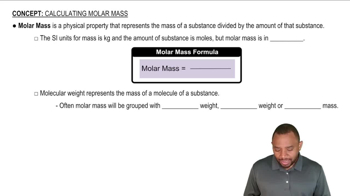
Molar Mass
Molar mass is the mass of one mole of a substance, typically expressed in grams per mole (g/mol). It is calculated by summing the atomic masses of all the atoms in a chemical formula. For cocaine (C17H21NO4), the molar mass is determined by adding the contributions from carbon, hydrogen, nitrogen, and oxygen atoms present in the compound.
Recommended video:
Guided course
Molar Mass Concept
Percentage by Mass
Percentage by mass is a way to express the concentration of a particular element in a compound. It is calculated by dividing the mass of the element in one mole of the compound by the total molar mass of the compound, then multiplying by 100. This calculation helps in understanding the composition of the compound in terms of its constituent elements.
Chemical Formula Interpretation
A chemical formula provides information about the types and numbers of atoms in a molecule. In the case of cocaine, C17H21NO4 indicates that the molecule contains 17 carbon atoms, 21 hydrogen atoms, 1 nitrogen atom, and 4 oxygen atoms. Understanding how to interpret this formula is essential for calculating the mass contributions of each element and ultimately determining the percentage by mass of oxygen.
Recommended video:
Guided course
Intepreting the Band of Stability
Related Practice
Textbook Question
2
views
Textbook Question
Calculate the percentage by mass of oxygen in the following compounds: b. codeine, C18H21NO3
2
views
Textbook Question
Calculate the percentage of carbon by mass in each of the compounds represented by the following models: (a)
395
views
Textbook Question
Calculate the percentage by mass of the indicated element in the following compounds: a. carbon in acetylene, C2H2, a gas used in welding
2
views
Textbook Question
Calculate the percentage by mass of the indicated element in the following compounds: f. carbon in capsaicin, C18H27NO3, the compound that gives the hot taste to chili peppers.
2
views
Textbook Question
Balance the following equations and indicate whether they are combination, decomposition, or combustion reactions: a. PbCO3(s) → PbO(s) + CO2(g)
2
views