Write balanced chemical equations corresponding to each of the following descriptions: c. Solid zinc metal reacts with sulfuric acid to form hydrogen gas and an aqueous solution of zinc sulfate.
Ch.3 - Chemical Reactions and Reaction Stoichiometry

Brown15th EditionChemistry: The Central ScienceISBN: 9780137542970Not the one you use?Change textbook
Chapter 3, Problem 16c
Write balanced chemical equations to correspond to each of the following descriptions: (c) Phosphine, PH3(g), combusts in oxygen gas to form water vapor and solid tetraphosphorus decaoxide.
Verified step by step guidance1
Identify the reactants and products in the chemical reaction: Phosphine \((\text{PH}_3)\) and oxygen gas \((\text{O}_2)\) are the reactants, while water vapor \((\text{H}_2\text{O})\) and solid tetraphosphorus decaoxide \((\text{P}_4\text{O}_{10})\) are the products.
Write the unbalanced chemical equation using the chemical formulas: \(\text{PH}_3(g) + \text{O}_2(g) \rightarrow \text{H}_2\text{O}(g) + \text{P}_4\text{O}_{10}(s)\).
Balance the phosphorus atoms: Since there are 4 phosphorus atoms in \(\text{P}_4\text{O}_{10}\), place a coefficient of 4 in front of \(\text{PH}_3\) to balance the phosphorus atoms.
Balance the hydrogen atoms: With 4 \(\text{PH}_3\) molecules, there are 12 hydrogen atoms, so place a coefficient of 6 in front of \(\text{H}_2\text{O}\) to balance the hydrogen atoms.
Balance the oxygen atoms: Count the total number of oxygen atoms needed on the product side and adjust the coefficient of \(\text{O}_2\) on the reactant side to balance the equation.

Verified video answer for a similar problem:
This video solution was recommended by our tutors as helpful for the problem above.
Video duration:
1mWas this helpful?
Key Concepts
Here are the essential concepts you must grasp in order to answer the question correctly.
Combustion Reactions
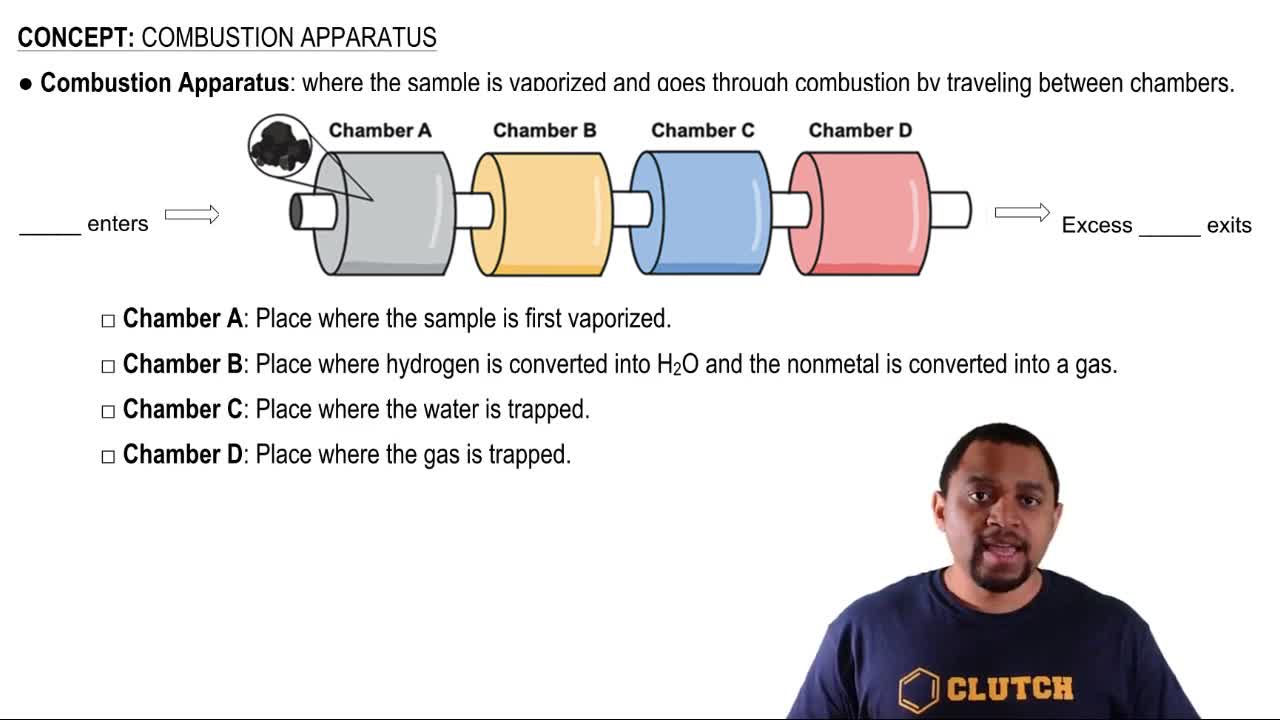
Combustion reactions involve the reaction of a substance with oxygen, typically producing heat and light. In organic chemistry, these reactions often yield carbon dioxide and water, but in the case of phosphine (PH3), the products include water vapor and tetraphosphorus decaoxide (P4O10). Understanding the general form of combustion reactions is essential for writing balanced equations.
Recommended video:
Guided course
Combustion Apparatus
Balancing Chemical Equations
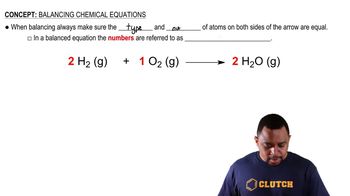
Balancing chemical equations is the process of ensuring that the number of atoms for each element is the same on both sides of the equation. This is crucial for obeying the law of conservation of mass, which states that matter cannot be created or destroyed in a chemical reaction. Each element's coefficients must be adjusted to achieve balance, reflecting the stoichiometry of the reaction.
Recommended video:
Guided course
Balancing Chemical Equations
Stoichiometry
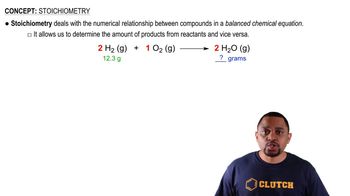
Stoichiometry is the study of the quantitative relationships between the amounts of reactants and products in a chemical reaction. It allows chemists to predict how much of each substance is consumed or produced. In the context of the combustion of phosphine, stoichiometry helps determine the correct coefficients needed to balance the equation, ensuring that the proportions of reactants and products are accurately represented.
Recommended video:
Guided course
Stoichiometry Concept
Related Practice
Textbook Question
2
views
Textbook Question
Write balanced chemical equations to correspond to each of the following descriptions: (a) When sulfur trioxide gas reacts with water, a solution of sulfuric acid forms. (b) Boron sulfide, B2S3(s), reacts violently with water to form dissolved boric acid, H3BO3, and hydrogen sulfide gas.
879
views
Textbook Question
(b) What products form in this reaction?
447
views
Textbook Question
(a) When a compound containing C, H, and O is completely combusted in air, what reactant besides the hydrocarbon is involved in the reaction?
1254
views
Textbook Question
Balance the following equations: d, NaN3(π )+HNO2(ππ)βΆN2(π)+NO(π)+NaOH(ππ)
4
views