
Textbook Question
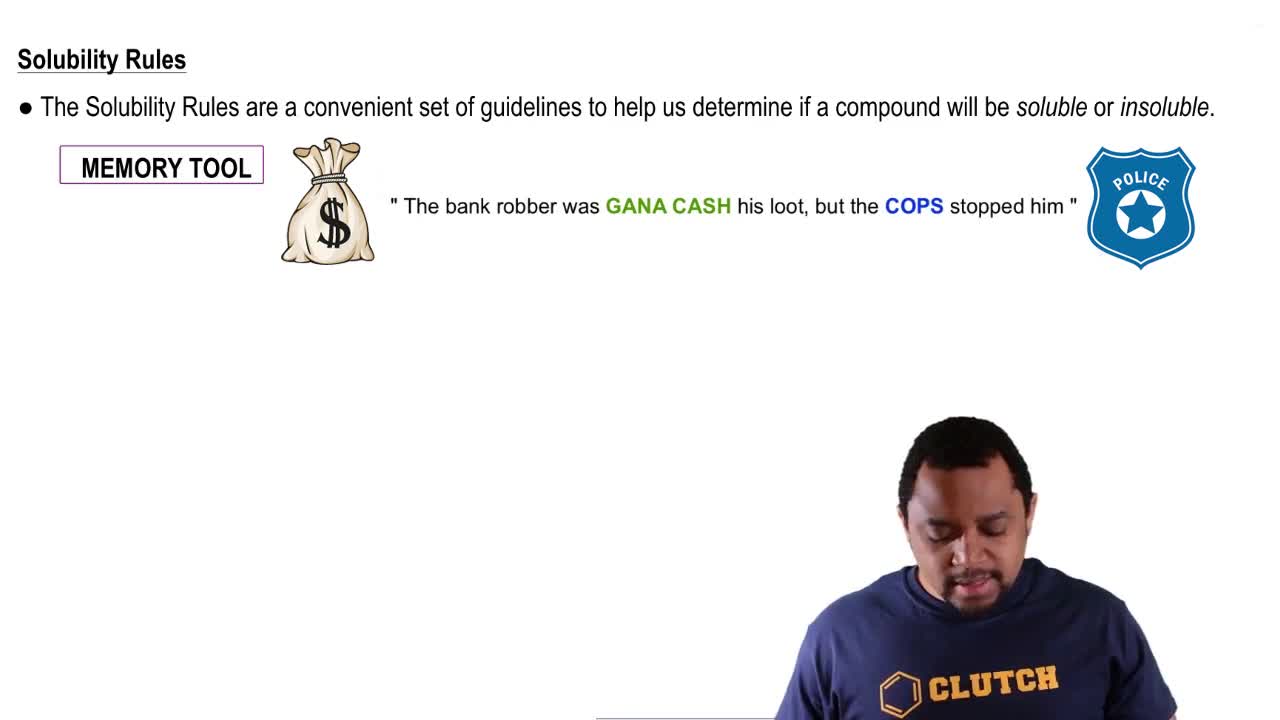
Identify the precipitate (if any) that forms when the following solutions are mixed, and write a balanced equation for each reaction. b. KOH and Cu(NO3)2
3
views

 Verified step by step guidance
 00:28
00:28
 02:11
02:11 02:04
02:04Identify the precipitate (if any) that forms when the following solutions are mixed, and write a balanced equation for each reaction. b. KOH and Cu(NO3)2
Acetone, CH3COCH3, is a nonelectrolyte; hypochlorous acid, HClO, is a weak electrolyte; and ammonium chloride, NH4Cl, is a strong electrolyte. (a) What are the solutes present in aqueous solutions of each compound? What solute particles are present in an aqueous solution of HClO?
Acetone, CH3COCH3, is a nonelectrolyte; hypochlorous acid, HClO, is a weak electrolyte; and ammonium chloride, NH4Cl, is a strong electrolyte. (b) If 0.1 mol of each compound is dissolved in solution, which one contains 0.2 mol of solute particles, which contains 0.1 mol of solute particles, and which contains somewhere between 0.1 and 0.2 mol of solute particles?
Acetone, CH3COCH3, is a nonelectrolyte; hypochlorous acid, HClO, is a weak electrolyte; and ammonium chloride, NH4Cl, is a strong electrolyte. (a) What are the solutes present in aqueous solutions of each compound? What solute particles are present in an aqueous solution of CH3COCH3?
Predict whether each of the following compounds is soluble in water: d. Al(OH)3
Which ions remain in solution, unreacted, after each of the following pairs of solutions is mixed? (a) potassium carbonate and magnesium sulfate