
Textbook Question
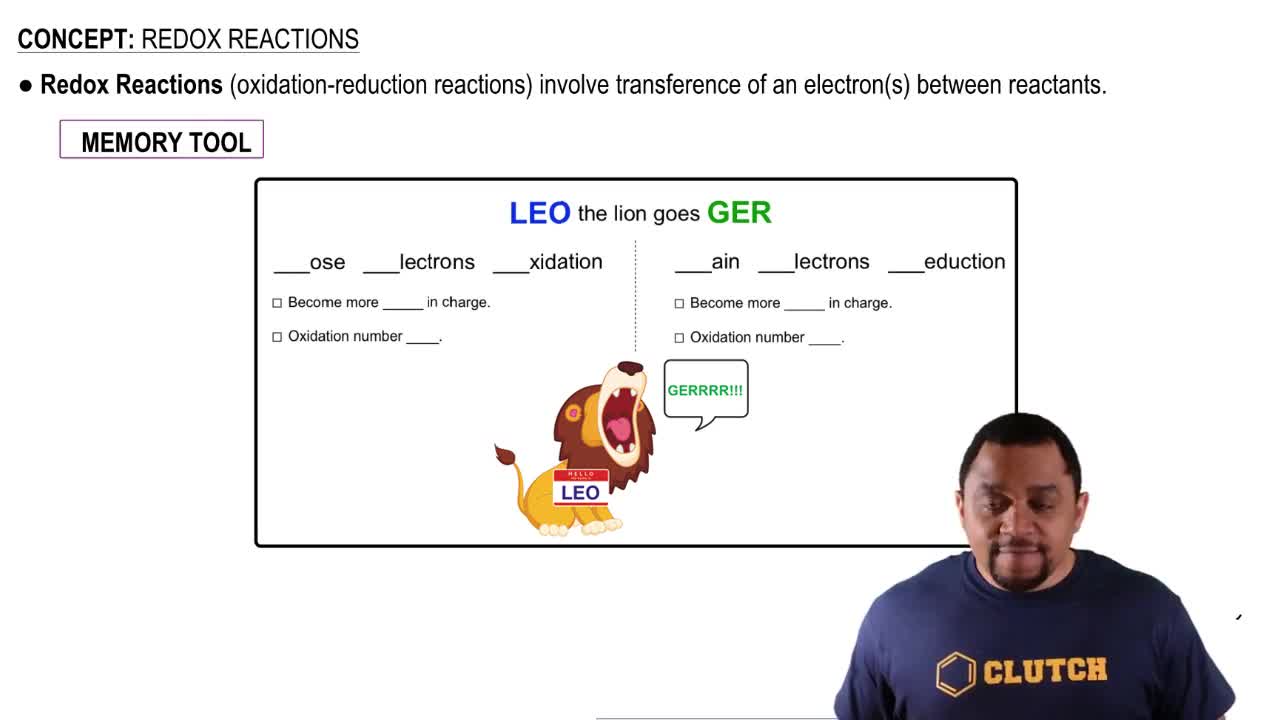
Determine the oxidation number for the indicated element in each of the following substances: f. Cr in BaCrO4.
3
views

 Verified step by step guidance
 01:53
01:53
 02:25
02:25Determine the oxidation number for the indicated element in each of the following substances: f. Cr in BaCrO4.
Which element is oxidized, and which is reduced in the following reactions? (a) N2(g) + 3 H2(g) → 2 NH3(g)
Using the activity series (Table 4.5), write balanced chemical equations for the following reactions. If no reaction occurs, write NR. (a) Iron metal is added to a solution of copper(II) nitrate (b) zinc metal is added to a solution of magnesium sulfate
Write balanced net ionic equations for the reactions of b. aluminum with formic acid, HCOOH. Hint: These reactions produce a gas.
Write balanced molecular and net ionic equations for the reactions of (b) dilute sulfuric acid with iron Hint: These reactions produce a gas.
Which element is oxidized, and which is reduced in the following reactions? (c) Cl2(aq) + 2 NaI(aq) → I2(aq) + 2 NaCl(aq) (d) PbS(s) + 4 H2O2(aq) → PbSO4(s) + 4 H2O(l)