(a) According to the first law of thermodynamics, what quantity is conserved?
Ch.5 - Thermochemistry

Brown15th EditionChemistry: The Central ScienceISBN: 9780137542970Not the one you use?Change textbook
Chapter 5, Problem 21c
(c) By what means can the internal energy of a closed system increase?
Verified step by step guidance1
Understand that internal energy (U) of a closed system can change through heat (q) and work (w) based on the first law of thermodynamics.
Recall the first law of thermodynamics: \( \Delta U = q + w \), where \( \Delta U \) is the change in internal energy.
Identify that internal energy increases when the system absorbs heat (q > 0) from the surroundings.
Recognize that internal energy also increases when work is done on the system (w > 0), such as compression work.
Conclude that both heat absorption and work done on the system contribute to an increase in internal energy.

Verified video answer for a similar problem:
This video solution was recommended by our tutors as helpful for the problem above.
Video duration:
51sWas this helpful?
Key Concepts
Here are the essential concepts you must grasp in order to answer the question correctly.
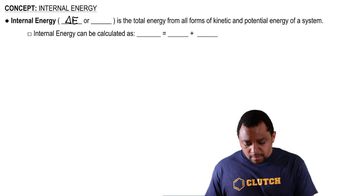
Internal Energy
Internal energy is the total energy contained within a system, encompassing both kinetic and potential energy of the particles. It is a state function, meaning it depends only on the current state of the system, not on how it reached that state. Changes in internal energy can be observed through heat transfer and work done on or by the system.
Recommended video:
Guided course
Internal Energy
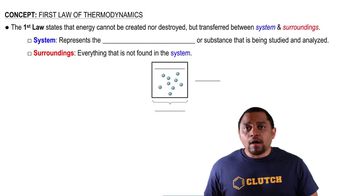
First Law of Thermodynamics
The First Law of Thermodynamics states that energy cannot be created or destroyed, only transformed from one form to another. In a closed system, the change in internal energy is equal to the heat added to the system minus the work done by the system. This principle is fundamental in understanding how energy transfers affect a system's internal energy.
Recommended video:
Guided course
First Law of Thermodynamics
Heat and Work
Heat and work are two primary means by which energy can be transferred into or out of a system. Heat refers to energy transfer due to temperature differences, while work involves energy transfer resulting from forces acting over distances. Both processes can lead to an increase in a system's internal energy, depending on the direction of energy flow.
Recommended video:
Guided course
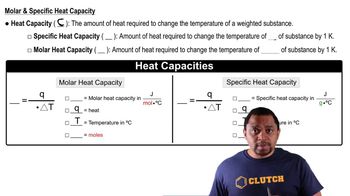
Heat Capacity
Related Practice
Textbook Question
577
views
Textbook Question
Calculate ΔE and determine whether the process is endothermic or exothermic for the following cases: (a) q = 0.763 kJ and w = -840 J.
1056
views
Textbook Question
Predict the chemical formula of the ionic compound formed between the following pairs of elements: (a) Al and F
2
views
Textbook Question
A gas is confined to a cylinder fitted with a piston and an electrical heater, as shown here:
Suppose that current is supplied to the heater so that 100 J of energy is added. Consider two different situations. In case (1) the piston is allowed to move as the energy is added. In case (2) the piston is fixed so that it cannot move. (a) In which case does the gas have the higher temperature after addition of the electrical energy?
753
views